How I Want You to Read This
I did not write this as a scientific paper, and I am not going to pretend it is one. It is something I think is rarer and, in its own way, harder: an honest attempt to lay the provable beside the unprovable and ask whether the seam between them is telling us something true.
Everything in the first half of this — the radiation physics, the forensic wounds, the Hebrew letter-symbolism, the dates and the documents — is sourced and checkable, and I want you to check it. Every claim of fact carries a number that points to a real paper, a real translation, or a real archive, listed in full at the end. Where the record is contested, I say so, because I am not interested in an argument that only survives by hiding the other side.
The rest is me. It is the reading of a man who has spent years inside many rooms of the world's faiths and meditations — Christian, Jewish, Vedic, Buddhist, Hermetic — and who saw something that, once I saw it, I could not un-see. When I move from the documented ground into my own interpretation, I will tell you plainly, so you always know which is which. And there is a testimony at the end that is purely mine — the experience underneath all of it, and the reason I believe what I have put together here.
I claim no authority but the sources I cite, the experience I have lived, and the witness of the Spirit. I am not asking you to take my word for it. I am asking you to look at what I have laid out, and weigh it for yourself. Read it the way you would receive a letter that has been a long time coming.
I. The Observation
Look at the Shroud of Turin the way almost no one looked at it for nineteen centuries — as a photographic negative.
That is not a figure of speech. In May of 1898, an Italian lawyer and amateur photographer named Secondo Pia was permitted to photograph the cloth, and when he developed the glass plate in his darkroom he nearly dropped it. The negative of his photograph resolved into a positive image — a coherent, luminous human face, with the light and shadow correctly arranged, as though the cloth itself were a photographic negative that had been waiting one thousand nine hundred years for the technology that could read it. The image on the linen is tonally inverted. Develop the inversion and the man appears.
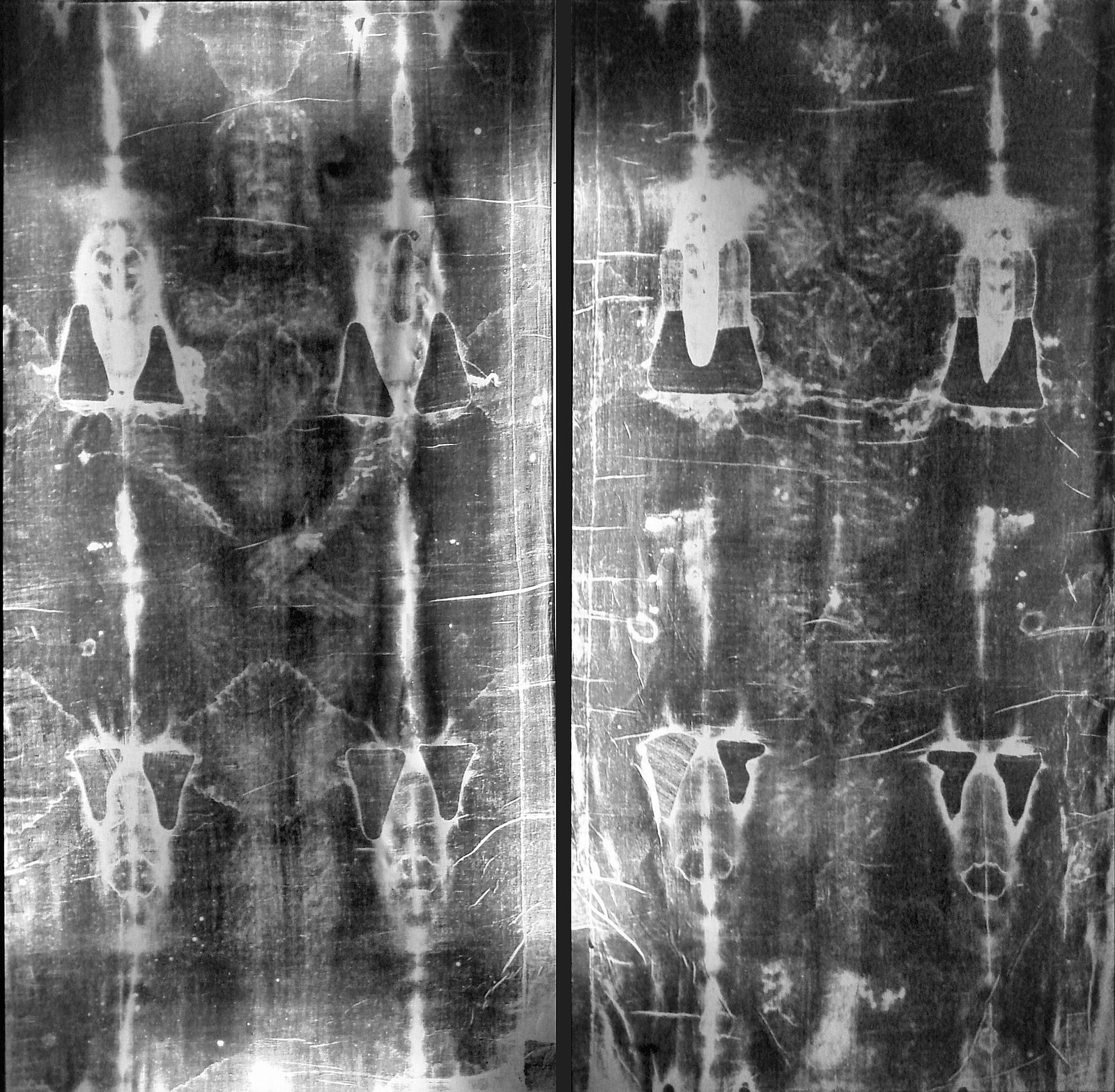
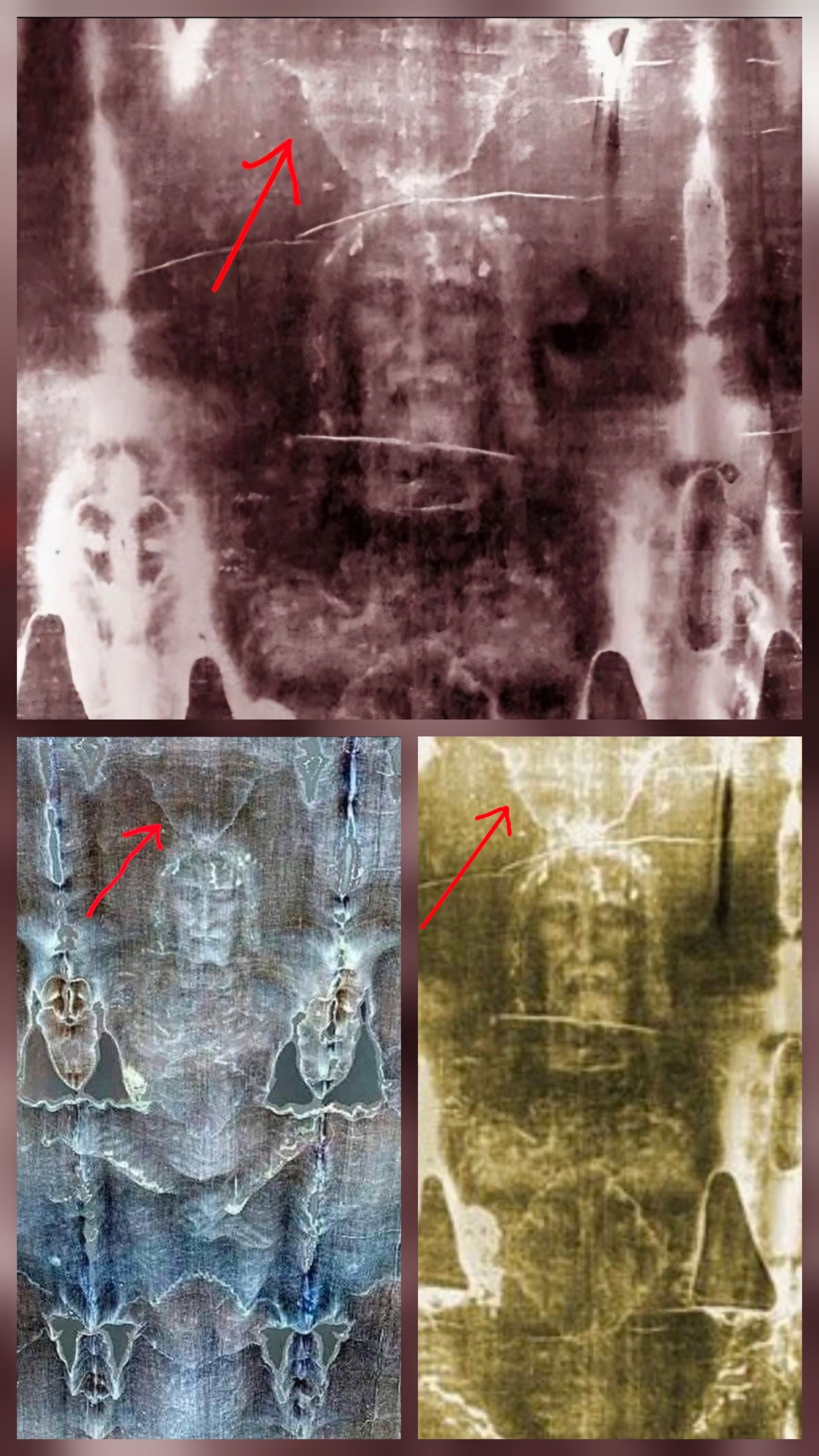
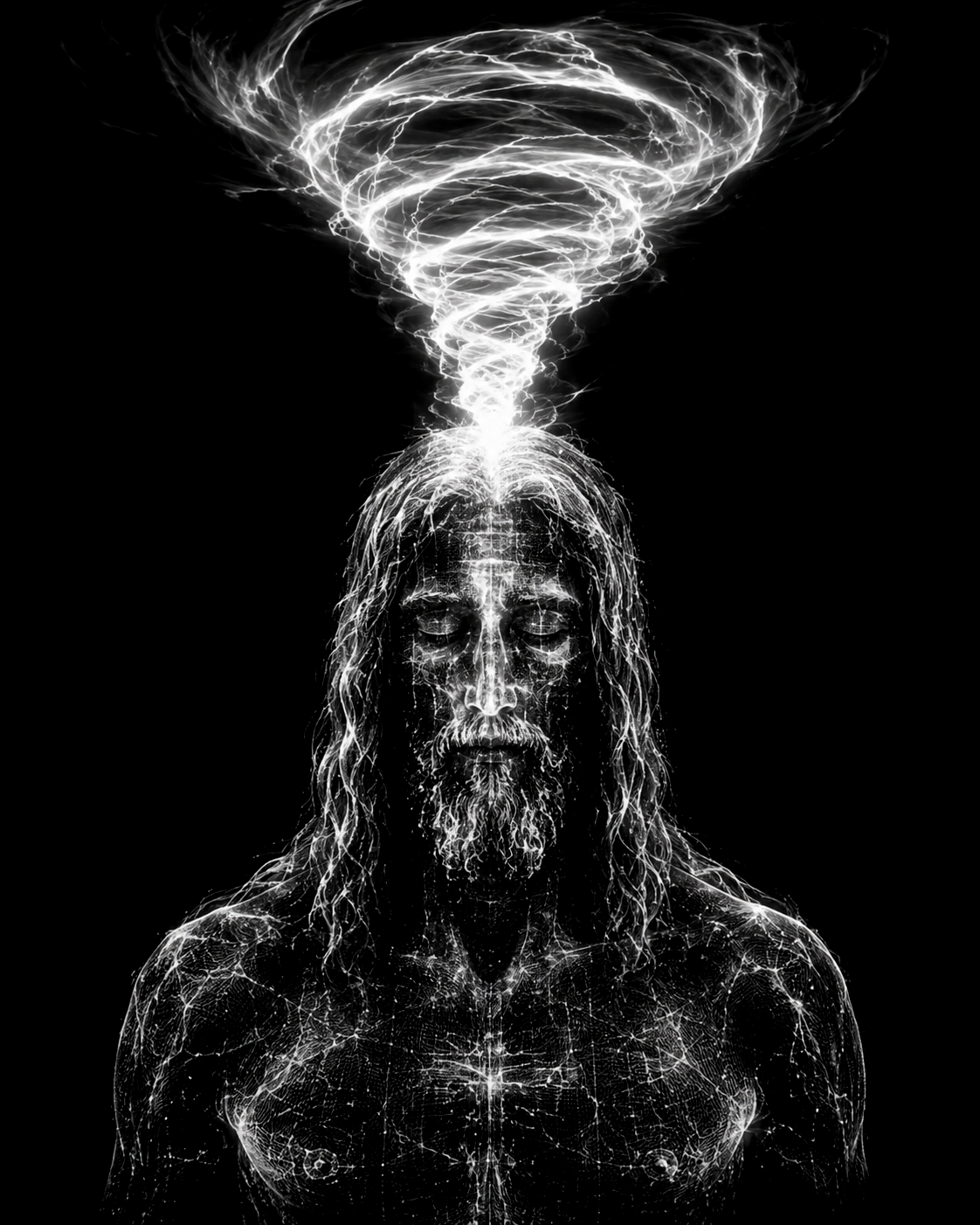
It is in that developed negative — the one where the face becomes a face — that my observation lives. Above the head of the figure, in the region directly over the crown of the skull, there is something. Not the orderly fade of cloth lifting away from flesh. Something structured. A disturbance in the field. When I look at it with the eyes of someone who has sat with the diagrams of a dozen traditions, it reads as an energy vortex — a swirl, a column, a wheel of energy standing upright over the place where every one of those traditions, independently, said the divine enters and leaves the human being.
Let me say a word about that word, because I will use it throughout. I call the structure a vortex — more precisely an energy vortex, or the vortex of divinity — because that is what I am proposing it to be: not a meteorological swirl but the visible turning-point of the connection between a human being and God. The modern manifestation teachers who follow the "Teachings of Abraham" reach for the same word; in their teaching, Source is the authority behind everything — the wellspring from which all that exists is derived — and they speak of a Source Vortex, capitalizing Source because they will not say God.57 Here is what I am actually suggesting: that this structured Light above the head is the real connection to the very thing they are reaching for when they say Source — what I call the Divinity. I have no such reservation about the name. The vortex is the doorway of the Holy Spirit. It is our connection to the divine — to the Higher Self, if you like that language, and to God, if you prefer the plain word.
Here is my claim, stated once, cleanly, so that everything after it can be tested against it:
That structured region above the head is not an accident of the cloth. It is the visible signature of the thing the mystics named. It is the Crown. It is Keter. It is the Godhead — the point, a hand's breadth above the skull, where the infinite touches the finite — and the Shroud caught its imprint at the one moment in recorded history when that point is said to have opened all the way.
And here is a detail I want you to see for yourself, because the image itself quietly confirms an ancient phrase. Take that same developed negative and measure two lengths against each other: the length of a hand, and the height of the structured Light standing above the skull. They are the same. The vortex above the head rises to very nearly one hand's length — a literal hand's breadth — so that the old description the mystics reached for when they spoke of the Crown, a hand's breadth above the head, turns out not to be a poetic guess but a measurement the cloth has been keeping all along. The metaphor and the photograph agree.
But I think there is a more useful question than merely is this real, and I mean to answer it too. The deeper questions are these: how is this reached? Is it achievable? And once it is achieved, what do you experience — what can you actually do with it? Those questions are not idle to me. I answer them, as far as I am able, in the practical path near the end, and in my testimony that closes this paper. Everything in between exists to earn the right to ask them.
II. The Science of the Gap
I want to begin with what is hardest to wave away, because it comes from the people least interested in mysticism: the physicists and the forensic doctors.
What is actually missing
In 1978, a team of American scientists — the Shroud of Turin Research Project, STURP — was granted five days and direct, hands-on access to the cloth. They arrived with X-ray equipment, spectrometers, microscopes, and the working assumption, held by several of them, that they would find a painting. They did not. The official summary of their conclusions, written up by the physician and team member John Heller, states the findings without ornament: the image "is not the product of an artist"; "no pigments, paints, dyes or stains have been found on the fibrils"; the bloodstains test positive for human blood components including serum albumin; and, in the sentence that has haunted the field ever since, "there are no chemical or physical methods known which can account for the totality of the image."9
I want to be precise about what STURP did and did not say, because the popular retelling overstates it, and I refuse to build on sand. STURP did not declare the Shroud authentic. It did not date the cloth. It did not endorse any mechanism — not radiation, not scorching, not the supernatural. It concluded, narrowly and honestly, that it could not explain the image and that the image is not a painting. That is the real, defensible foundation, and I keep it front and center on purpose. Build on that and you build on rock; build on "scientists proved it was a miracle" and you build on sand, because they did no such thing. It is precisely this restraint that gives everything afterward its strength.
Now to the gap. Among the documented characteristics of the image is one that the popular literature races past and the technical literature states flatly: there is no image of the top of the head, and no image of the sides of the body. The cloth records the front of the man and the back of the man — two full-length impressions, head-to-head — but where the crown of the skull should join them, there is nothing. The frontal image and the dorsal image do not meet over the top of the head. They stop, and between them is blank linen.
This is not folklore. It is in the peer-reviewed and conference record. The Spicer–Toton image-formation paper lists it explicitly among the STURP-derived constraints any theory must satisfy: "There is no image of the top of the head or sides of the body enclosed by the cloth."2 The observation traces back to the foundational 1984 study in the optics literature by John Jackson, Eric Jumper, and William Ercoline, published in Applied Optics — a mainstream physics journal — which established that image intensity correlates with the three-dimensional distance between cloth and body, and mapped the consequences, including the head region.1 That 1984 Applied Optics paper is the single strongest, most checkable anchor in the entire Shroud literature. If you check one thing I cite, check that.
The man in the cloth — what the wounds testify
Before I reach for the vortex, I want you to sit a while longer with the body, because the Shroud is not only an unexplained image. It is the forensic record of a specific execution, and that record matches one death in particular with a precision that ought to stop you cold.
The back, shoulders, and legs carry more than a hundred small paired wounds — the literature varies on the exact count, so I will say over a hundred — each shaped like a tiny dumbbell, exactly the print left by the lead pellets (plumbatae) tied to the thongs of a Roman flagrum.42 This is not artistic flogging. It is the Roman scourge, applied by two men from both sides, the implement the Gospels name.
The hands show a single nail wound, and here the cloth corrects the art. For two thousand years painters put the nails through the palms. The French surgeon Pierre Barbet, working from the Shroud and from cadaver experiments, argued that the nail actually passed through the wrist — through the gap anatomists call Destot's space (a small gap between the wrist bones) — because a palm cannot bear a body's hanging weight; it tears.43 I will be honest with you: the forensic pathologist Frederick Zugibe later disputed Barbet's anatomy and argued for a different entry point, and that debate is genuinely open.44 But both men agree on the deeper point — the wound is where crucifixion actually wounds, not where devotional art imagined it.
The scalp is punctured not in a tidy circlet around the brow but across the whole dome of the head — forehead to nape — the unmistakable signature of a cap of thorns pressed down over the entire skull.45 Hold that detail. I will come back to it, because it is the hinge of this whole paper.
The right side bears a single elliptical wound between the ribs, and from it two separated flows — one of blood, one of a clear serum, the "blood and water" that John alone records: "one of the soldiers pierced his side with a spear, and at once there came out blood and water" (John 19:34).47 The legs are not broken — and John, again alone, tells us why that matters: "they did not break his legs… that the Scripture might be fulfilled: 'Not one of His bones will be broken'" (John 19:33, 36).47
And the chemistry tells a sequence. The STURP chemists John Heller and Alan Adler found that the bloodstains are real blood — heme, bilirubin, serum-retraction halos visible under ultraviolet that only form around a genuine clot — and that there is no image underneath the blood. The blood was on the cloth first; the image formed after, around it.46 Whatever made the image did not paint the wounds in. It found them already there.
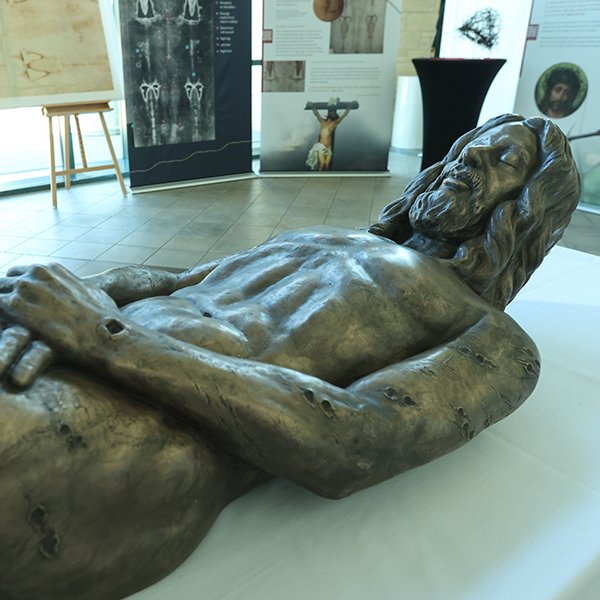
I have studied these wounds for a long time, and I will say what the careful papers only imply: I believe this may very well be the actual face and body of Jesus Christ. The scourging, the cap of thorns over the whole head, the nail through the wrist, the pierced side with blood and water, the unbroken bones fulfilling prophecy — every one of them is the Passion, written in blood on linen. I do not need it to stand as a court verdict. I need you to feel the weight of it. Something divine is in this cloth.
I will set aside two popular "extra" proofs, in the name of that same honesty. The claims of first-century pollen (Max Frei) and of Pilate-era coins resting on the eyes are contested — the pollen work is dogged by methodological and fraud-adjacent controversy, and the "coins" are almost certainly pareidolia (the trick of seeing real shapes, like faces, in a random pattern) in a coarse weave.48 I do not need them, and I will not lean on them. The wounds are enough.
Why I call it an energy vortex — and why that word is also dangerous
Here is the first thing a hostile reader will reach for, so I am going to hand it to them myself.
No peer-reviewed Shroud paper uses the word vortex. The documented fact is an absence — no top-of-head image — together with a gradient: the image darkens where the cloth was closer to the body and fades to nothing on surfaces that were tangent, edge-on, to whatever formed it.1,2 The mainstream reading of the gap is almost boringly geometric: a roughly flat cloth was not molded down over the curve of the crown, so the crown left no mark. A skeptic can stop there, and many do.
What I see in the developed negative — a swirl, a standing column, a wheel — is my interpretation of the image in that blank and bordering region, not a quantity reported by a laboratory. I will not pretend otherwise, because pretending otherwise is exactly how a real insight gets itself dismissed. The science gives me the anomaly: a structured absence at the precise anatomical point the mystics cared about, in an image no one has reproduced. The meaning of that anomaly is my leap. I hold the two apart on purpose. Weld them together and call it proof, and the first hostile reader pulls it apart in a sentence. Keep them honest and distinct, and the case is strong.
The theories that try to fill the gap
What could leave a front and a back but no sides and no crown? Every serious attempt arrives, by different roads, at the same strange idea: the image was made not by contact, not by pigment, but by radiation traveling vertically — straight up and straight down from the body, not sideways.
John Jackson, the STURP physicist, developed this furthest. He proposed that the image records vertically-projected information — and, in his most radical formulation, that the cloth at some moment collapsed through a body that had become "mechanically transparent," recording, as it fell, a time-integrated map of a form that was no longer solid.3,4 A front and a back with no sides, no top, no contact in the middle — because there was, at that instant, no fully solid middle to touch. It is speculative physics wrapped around a theological intuition, and Jackson presents it as a hypothesis, not a proof. But it is a real, published one, and it exists because the conventional explanations strain against the data.
Robert Rucker carried the radiation idea into nuclear language, proposing a "vertically collimated radiation burst" — radiation released in a vertical column — as the only geometry that gives the correct face proportions while leaving sides and crown unmarked, and argued a neutron component could even reset the carbon clock.5 His work is published but contested, and not mainstream physics; I cite it as a serious named hypothesis, and I label it that way.
From the University of Padua, Giulio Fanti approached through corona discharge — a structured electrical field of the kind that ionizes the air around high-voltage conductors. His image-formation studies are real and peer-reviewed.6 The phrase often attached to his name — "divine photography," the "tens of millions of volts" — comes from his popular writing and a later book, not the technical papers, and I attribute it there.6
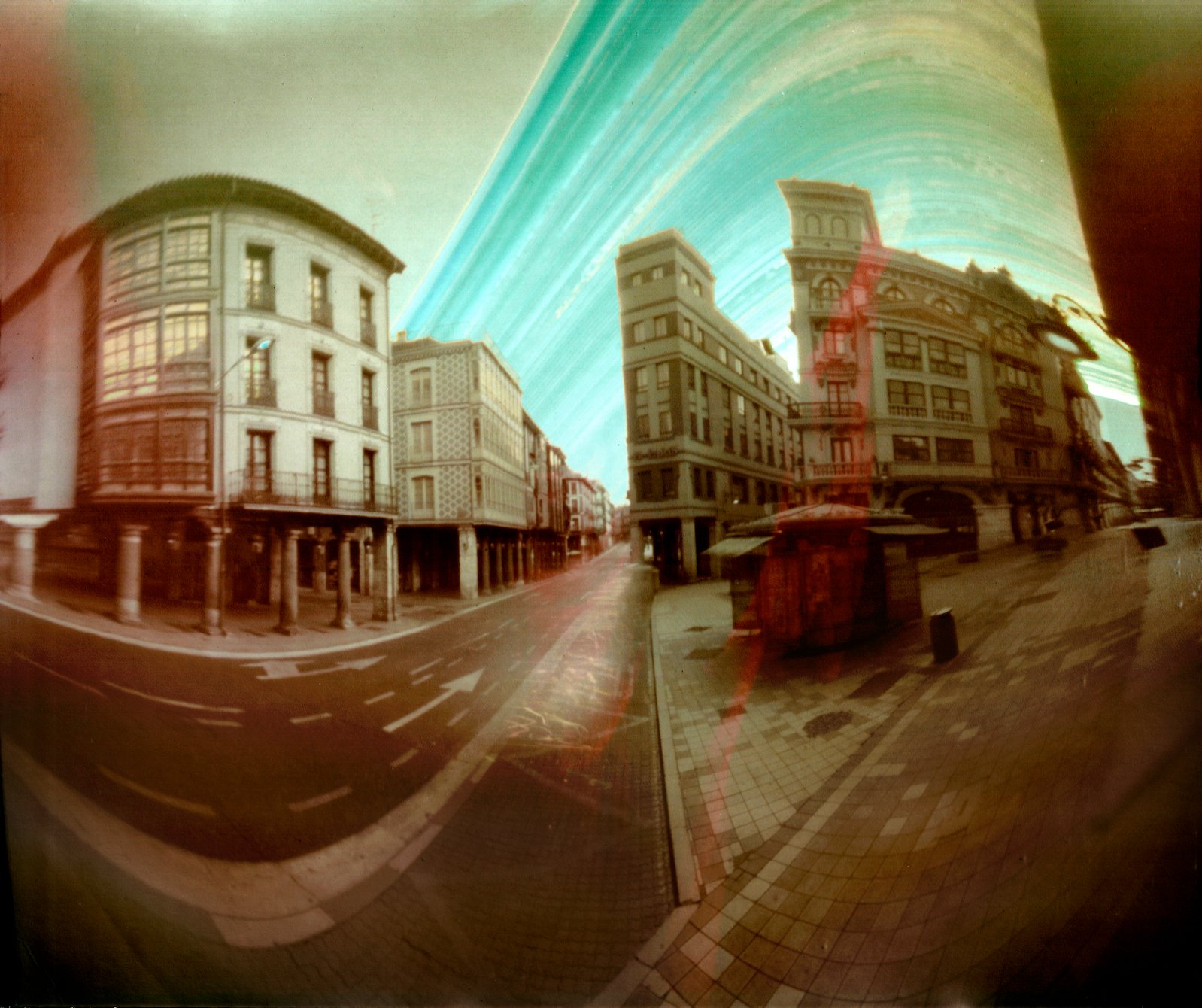
But that phrase opens a door I want to walk through. Consider the simplest camera that exists: a sealed box with a single pinhole. Light passing through that one small aperture projects, on the far inner wall, a complete inverted image of whatever is outside — the camera obscura, described already by Ibn al-Haytham a thousand years ago.49 Push it further: line a sealed can with photographic paper, prick one hole, and leave it pointed at the sky for months. The technique is called solargraphy, and what you get is eerie — the sun's daily arcs burned directly onto the paper as luminous trails, an image made by nothing but light and time, with no lens and no hand.50 I am not claiming the Shroud is a solargraph. But I find the analogy instructive, and it is worth showing in the recording: an image of pure light, imprinted on a flat surface from the inside, by radiation alone — eerily close to the thing we are looking at. Light, it turns out, knows how to write its own picture.
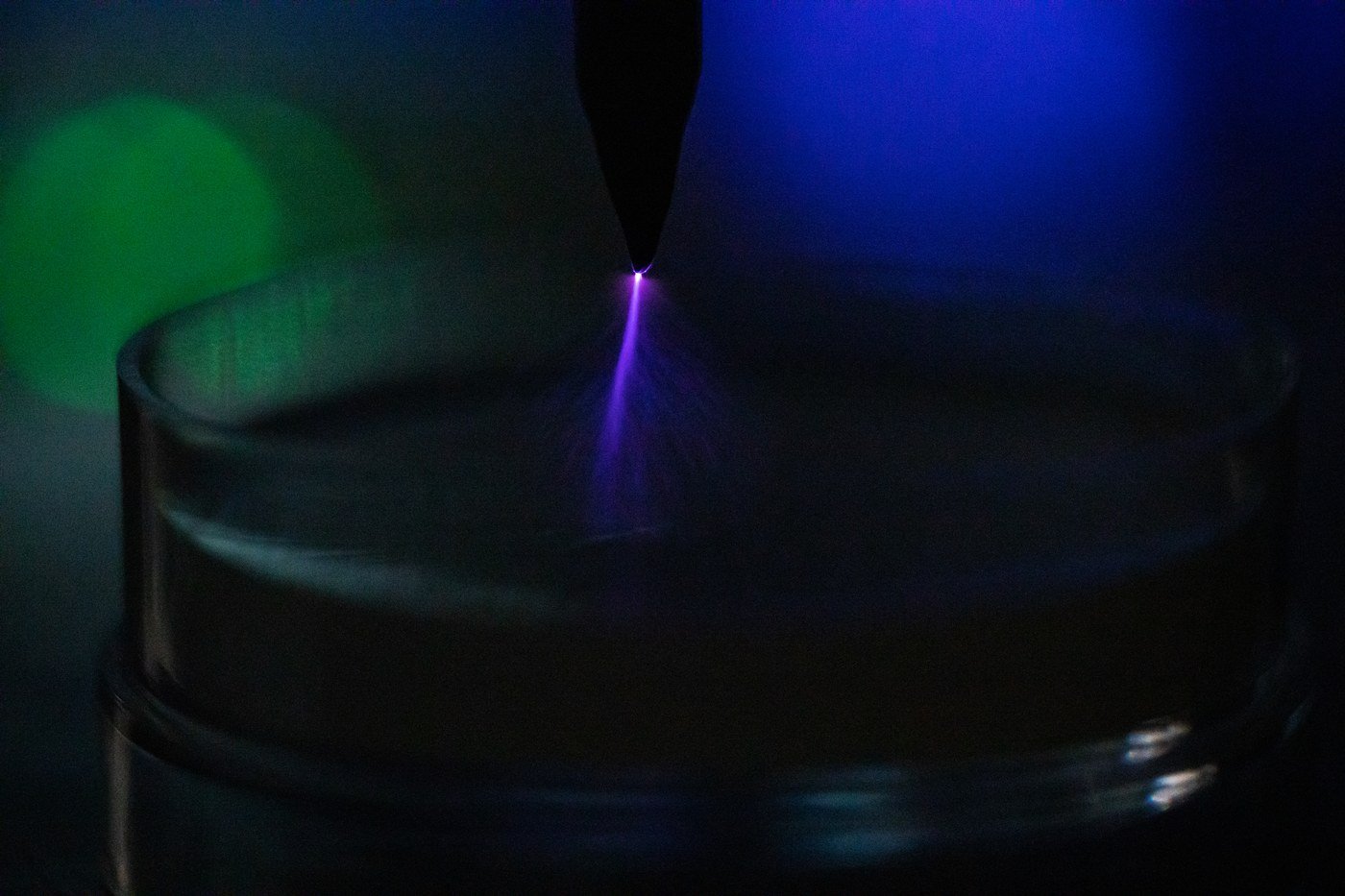
And from ENEA, the Italian national energy agency, came the most quantitatively startling result. Paolo Di Lazzaro and colleagues spent years firing ultraviolet excimer lasers at raw linen, trying to reproduce a coloration that sits only on the topmost fibers, a few thousandths of a millimeter deep, where no dye or scorch behaves. They succeeded — but only with pulses lasting mere nanoseconds, tens of billionths of a second.7 The dramatic press figures ("billions of watts," "exceeding all the ultraviolet sources available today") are extrapolations from ENEA's 2011 report; the defensible peer-reviewed result is nanosecond ultraviolet pulses, far beyond any medieval technology.7 I quote that, and the claim holds.
Notice what they are all circling. A front, a back, no sides, no crown. A coloration that sits on the surface like light, not paint. Blood laid down first and an image formed around it. An energy requirement that, taken at face value, exceeds human hands. Every serious mechanism points away from a brush and toward a burst — a vertical release of energy along the body's axis, most intense exactly where the cloth records nothing because the cloth was not what the energy was passing through. The gap above the head is not where the energy was weakest. It is where the energy was going straight up.
The believer's own physicist — the Uncreated Light
One published researcher came closer than any other to naming what I am naming — and stopped at the threshold. Because his road runs straight toward mine, I want to walk it slowly.
In 2019, at the Shroud conference in Ancaster, Canada, Mark Oxley presented "The Divine Light and the Shroud of Turin."8 Building on Jackson's "process unknown to modern science," Oxley argued that the image was formed by the Uncreated Light of Eastern Orthodox theology — and to understand that phrase is to understand half of what I am trying to show you.
The Eastern Church draws a distinction Western Christianity mostly forgot, and it is the key that unlocks the whole convergence. God's essence — what God is in Himself — is utterly unknowable, beyond all comprehension, forever hidden. But God's energies — His outflowing activity, His light, His glory — are real, are God, and can actually be participated in by a human being. This is the doctrine systematized in the fourteenth century by Gregory Palamas, defending the hesychast monks of Mount Athos who claimed that in deep stillness they beheld an actual divine light — not a metaphor, not a feeling, but the very Light that blazed from Christ on Mount Tabor at the Transfiguration, when "His face shone like the sun" (Matthew 17:2).8 Palamas insisted: the Tabor light was uncreated. It was God's energy made visible. And the monks, in stillness, were seeing the same light.
Behind Palamas stands Pseudo-Dionysius, for whom God is "the light which is the source of all light," the radiance from which all created light descends and to which the purified soul ascends.8 And behind both stands the conviction that the first thing God ever made was light — "Let there be light" (Genesis 1:3), spoken on the first day, before sun or star existed on the fourth. The light of Genesis 1:3 is not sunlight. It is something prior, something divine, the same hidden radiance the Jewish mystics would call Or HaGanuz (see the next section).
Now hold the pieces of Oxley's argument together. A body that emits Uncreated Light at the Resurrection — the same essence-energy distinction that lets a human participate in that light — the same Tabor radiance the hesychast monks beheld in stillness — formed, he proposes, the image on the cloth. The Transfiguration and the Resurrection as two unveilings of one Light, and the Shroud as the photograph of the second.
This is where my spirit leaps, and I want us to go all the way here. Oxley got it right and then he stopped at the edge. The Uncreated Light is the whole thing. It is the light Moses' face caught on the mountain, the light on Tabor, the light the monks see when they go silent — and I believe it is the light you and I can touch when we still ourselves completely and reach the top of the head. He proved the door. He just did not walk through it. (And so you know I am not asking you to take this on faith: I checked the Oxley paper against the source myself — it is real and online at the citation given.8 Open it. Verify it.)
Oxley got as far as Uncreated Light. He did not take the next step — he did not turn to the Jewish mystics who, eight hundred years earlier, had mapped that same Light to a precise location above the head, and given it a name. That step is mine to take. Let me take it now.
The objection I have to meet: the carbon date
The most informed skeptic in the room is already holding the answer he thinks ends the conversation, so I will meet it before he can throw it. In 1988, three laboratories radiocarbon-dated a sample from one corner of the Shroud and reported, in Nature, a date of roughly AD 1260–1390: medieval.11 That result has never been formally retracted. It is the orthodox scientific finding, and any honest case has to face it.
It has been challenged on a specific ground: that the sampled corner is not representative. The chemist Raymond Rogers — originally a skeptic — examined fibers from the radiocarbon corner and reported in Thermochimica Acta (2005) that they differ chemically from the main cloth, carrying cotton, dye, and vanillin (a compound that slowly fades out of old linen over the centuries) the rest lacks, consistent with a medieval "invisible reweave" repair to a damaged corner.12 More recently, De Caro and colleagues (2022) applied a structural X-ray method and reported a profile compatible with the first century.13
I have gone through this carefully, and I find the reweave answer compelling. The corner they cut was exactly where the cloth had been handled, mended, and rewoven over the centuries. So I do not believe the 1988 labs dated the whole Shroud. I believe they may well have dated a repaired corner and treated it as the relic. I have to say it carefully, because honesty is the whole point: the 1988 Nature date has never been formally retracted, and many scholars still hold it. But Rogers — a skeptic — gave a serious, peer-reviewed reason to doubt that the sampled corner was representative: the chemistry of those threads (cotton, dye, vanillin) is not the chemistry of the rest of the cloth. That is the hardest fact to wave away, and it is the one I rest on.
Here is the honest state of the question, stated plainly: the 1988 date stands as the orthodox finding, and the case for an earlier origin rests on disputing the sample rather than overturning the method — a case that is real, published, and contested, not settled. But I do not need the cloth to be first-century to make my argument about the image and its correspondences. I need only to tell you the truth about the date, and to let the convergence of meaning carry the weight.
Here is the whole arc of that scientific story laid on a single line, so you can see for yourself how the case has actually moved over a century — not toward a brush, but away from one:
III. The Crown — Keter and the Infinite Light
Now leave the laboratory with me and walk into a different kind of room, where men have been describing the top of the human head for a very long time. In the Kabbalah — the inner, mystical stream of Judaism — reality unfolds from the unknowable God through ten sefirot, ten emanations, arranged as the Tree of Life. The highest is Keter (כֶּתֶר). The word means Crown.
Not brain. Not mind. Crown — the thing worn above the head, encircling it, touching it but not contained by it. Keter is described as being above the head, not at it. As a crown sits on top of the head and encompasses it, the standard teaching runs, so Keter sits on top of all the other emanations and encompasses them all — it "refers to things that are above the mind's abilities to comprehend."15 It is the superconscious, the part of the divine outflow that transcends thought entirely.16 Picture Keter from directly overhead — an aerial view, looking straight down on the crown of a head. A ring of radiance encircling the skull from above. You have just drawn a halo. Every icon painter who ever ringed a saint's head with gold was drawing Keter seen from above. They may not have known what they were drawing. I think they were drawing this.
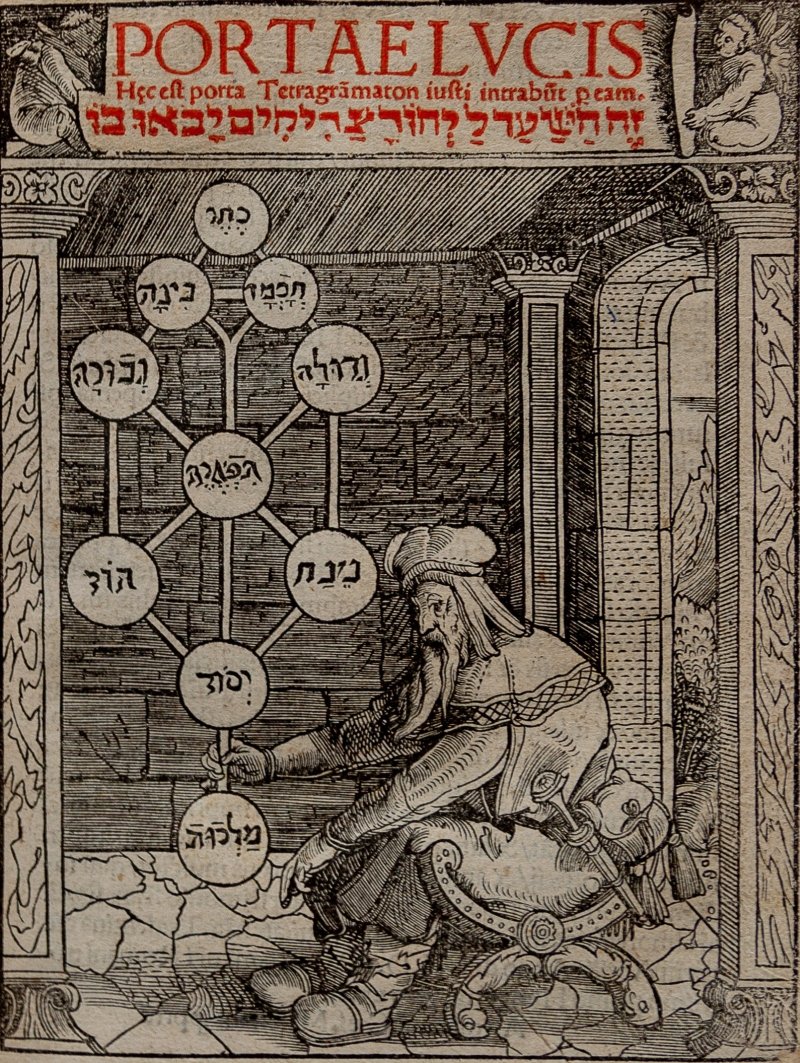
Above Keter is Ein Sof (אֵין סוֹף) — "Without End," the Infinite, the boundless essence no category can hold. Ein Sof cannot touch creation directly; it is too much. It reaches the world only through Keter, which the tradition calls the "lowest level" of the Light of the Infinite — Ohr Ein Sof — the first and highest emanation, and yet the lowest rung of the Infinite itself, the place where the boundless agrees to become a point.14 Keter is the doorway. It is where the Infinite Light first consents to be located.
And the doorway is not only a doctrine — Scripture keeps pointing at it. "The kingdom of God is within you," Jesus says (Luke 17:21) — and I will be honest: the Greek can also read "in the midst of you."56 But the indwelling itself is everywhere and unambiguous: "Do you not know that your body is a temple of the Holy Spirit within you?" (1 Corinthians 6:19); "you are God's temple and God's Spirit dwells in you" (1 Corinthians 3:16); "we will come to him and make our home with him" (John 14:23).56 The doorway is real, and Scripture says it opens inside you — your spirit the temple, the Holy Spirit the flame, Keter the opening through which the flame reaches the Infinite.
And what does that Light look like, in the tradition's own words? It is Or HaGanuz, the Hidden Light — the primordial light of the first day, hidden away for the righteous. It is Ayin — Nothingness — not empty but so full of pure potential it has no graspable content; the luminous Nothing from which everything comes.14,19 The Zohar calls it the most hidden of all hidden things. Brilliant, translucent, white — a radiance that is also a darkness to human eyes because it exceeds them.
Mark that phrase: hidden away for the righteous. I do not think that is arbitrary. I believe you have to be vibrating in a high state, a state of love, to truly reach this Light. "Blessed are the pure in heart, for they shall see God" (Matthew 5:8). The Light is not hidden by a lock. It is hidden by a frequency.
That belief deserves a name, because I lean on it throughout. The psychiatrist David R. Hawkins proposed a "Map of Consciousness," a scale running from roughly 20 (shame, the vibration nearest death and hate) up through 200 (courage, the turning point) to 500 (love) and beyond, toward enlightenment near 700–1000.52 I will say cleanly what it is and is not: this is Hawkins' own spiritual framework, built on a muscle-testing method that mainstream science does not validate — it is not measured physics.52 But as a map of the soul's states, it gives me a vocabulary, and I use it as such, and as the honest statement of my belief: that the energy vortex opens only to those operating in the higher frequencies of love, and closes to hatred and fear. I think the lowest of us — the ones who traffic in cruelty — cannot reach it at all, because the door does not open to that frequency.
And here I want to set down beside that belief the piece of this that is not my belief but measured science, so the frequency I am describing does not rest on Hawkins' map alone. The neuroscientist Andrew Newberg, at the University of Pennsylvania, put Tibetan Buddhist meditators and Franciscan nuns into a scanner at the height of deep meditation and prayer and imaged the brain with SPECT.68 At the peak — the very moment the practitioners described as union, as the boundary between themselves and God falling away — he found a measurable, repeatable drop in activity in the parietal lobe, the part of the brain that builds your sense of where your body ends and the world begins. When that orientation circuit goes quiet, the felt border between the self and everything else dissolves — exactly the self-transcendence the contemplatives of every tradition have always reported.68 That is not muscle-testing and it is not my framework; it is real, replicated, peer-reviewed neuroscience. And let me be clear about what it does and does not show: it measures the brain, not God — a scan can show the doorway swinging open, not what stands on the other side of it. I keep Hawkins for his vocabulary and for his honest insistence that the door opens to love — but the deeper claim, that when you still the self something genuinely changes inside a human being, Newberg watched happen in the living brain.
One correction I have to make cleanly here, because it is the most common error in popular Kabbalah and it would discredit my whole argument if I smuggled it in. There is a famous phrase — the First Swirlings, Rashith ha-Gilgalim, the Primum Mobile, the first whirling motion of the cosmos — almost irresistibly tempting to me, given the word vortex. But I have to flag it: that phrase belongs to Hermetic Qabalah, the Western system systematized by the Golden Dawn and popularized by Dion Fortune in 1935, not to classical Jewish Kabbalah.22 It is a real and beautiful correspondence within that Western tradition, and I will cite it — but only as what it is, keeping it labeled as Hermetic rather than letting it pass for the Zohar.
IV. The Crown of Thorns Was the Crown of God
This is the center of everything I am trying to show you. If one section of this is read aloud, slowly, in the recording, let it be this one.
In the Kabbalah, the four-letter divine Name, the Tetragrammaton, is mapped onto the ten sefirot. The letters carry the emanations. But Keter is a problem. Keter is too high, too transcendent, to be carried by any letter at all. The Infinite does not fit inside a character of the alphabet. So how is Keter represented?
By the thorn.
In the standard teaching, transmitted through the Chassidic masters and stated plainly in the accessible literature, the four letters map to the lower sefirot — but Keter is represented by the "thorn" of the yud, the tiny upward point atop the smallest Hebrew letter: "keter is represented by the 'thorn' of the yud, thus not by any letter but by a mere dot."14 The Hebrew is kotzo shel yud — the thorn, the spike, the little crowning point of the letter Yod. Not a letter. A thorn. The Godhead, the Crown, the highest and most hidden of all the emanations, is written in the tradition as a thorn.
And here is what stops me cold. Take that thorn — the upward point of the Yod, the symbol of Keter — and turn it upside down. Invert it. You get the very shape of the energy vortex I have been describing this whole paper: a point at the top, widening as it descends into the crown. The symbol of the Godhead, flipped, is the funnel of the Godhead pouring in. I do not believe in coincidences.
And here is the thing that took the breath out of me when I saw it: Jesus Himself names this letter and this thorn. "Till heaven and earth pass," He says, "one jot or one tittle shall in no wise pass from the law, till all be fulfilled" (Matthew 5:18).26 The jot is the yod — the smallest letter. The tittle is its little projecting point: the Greek is keraia, which means a little horn — the very thorn, the kotzo shel yud, that the Kabbalah uses to write Keter. So the smallest letter and its thorn-point are the one thing the Lord singles out as the part of the Word that cannot pass away — and then, a few chapters later, that same thorn is pressed in a crown onto His head. The keystone of this whole paper is not my own notion smuggled in from mysticism. It is sitting in the Sermon on the Mount, in His own mouth.
Now return with me to the man in the cloth. To understand what was placed on His head, go back to the first thorns in Scripture. When Adam fell, the curse fell on the ground: "cursed is the ground because of you… thorns and thistles it shall bring forth for you" (Genesis 3:17–18).54 Thorns enter the world as the very emblem of the curse — the sign of paradise lost, of a creation turned hostile, of humanity exiled from the immediate presence of God. For the whole sweep of Scripture, the thorn means the curse.
So when Roman soldiers wove a cap of thorns and pressed it down over the entire dome of His skull — and the Shroud confirms it was a cap over the whole crown, not a brow-circlet45 — they pressed the curse of Eden onto His head. The old Christian commentators saw it: "Did thorns come in with sin? He was crowned with thorns for us… being made a curse for us, and dying to remove the curse from us, he felt the pain and smart of those thorns" (Matthew Henry).54 Christ takes the curse of the Fall upon the exact summit of His body — and begins to reverse Eden from the top of the head down.
And now lay the two traditions on top of each other, because they describe the same square inch of skull. The Kabbalah: the thorn is Keter, the symbol of the Godhead, the Crown of the Infinite. The Passion: a cap of thorns is driven onto the crown of the head — the exact anatomical seat the Kabbalah calls Keter.
The soldiers intended mockery. They meant King of the Jews as a joke, and the thorns as the cruel furniture of it. The sign Pilate nailed above Him said as much, in three languages — Hebrew, Latin, Greek — for the whole world to read, and when the chief priests objected, Pilate refused to change it: "What I have written I have written" (John 19:19–22). Rome thought it was branding a failed pretender. In the symbolic language of the inner tradition, Rome was staging a coronation. They drove the symbol of the Crown of the Infinite into the anatomical location of the Crown of the Infinite, onto the head of a man whose followers would claim He was the Infinite made flesh — and onto that same crown they pressed the curse of Eden, so that the place of the curse and the place of the Godhead became, in Him, one point.
They could not have known the cap of thorns over the dome of the skull was the thorn-of-the-Yod made physical — the kotzo shel yud hammered onto the living Keter; the curse of Genesis and the Crown of the Zohar fused at a single bleeding point. The instrument of derision and the symbol of the Godhead are, in that tradition's own letters, the same shape in the same place.
This is the convergence that, as far as I have ever been able to find, has never been assembled into a single statement before. The thorn-as-Keter is documented Kabbalah.14 The thorn-as-curse is documented Scripture.54 The cap-of-thorns over the whole crown is documented from the Shroud and the Passion.45 The location is the same. The symbol is the same. The leap — that the mockery was, unknowingly, a true crowning, and that the cursed thing became the crowning thing — is my interpretation, and I offer it as such. But the pieces I built it from are not invented. They are each, separately, real, and they each, separately, point at the same spot above the human skull.
The Gnostic stream felt the edge of this: in that reading, the crown of thorns marks the forcing-open of the crown, the bringing of ordinary mind to silence so a higher consciousness can dawn through the opened top of the head. The worst thing human beings could do to a head, done to the one head, at the one point, in the one tradition where that point and that thorn already meant the Crown of God — and in the one Scripture where that thorn already meant the curse that He came to lift.
V. Voices Across Traditions — The Same Point, Many Tongues
A plain-words key for this section
Sahasrara — the crown energy-center in yoga, pictured as a flower of light on top of the head. · Brahmarandhra — the soft spot at the very top of the skull. · Phowa — a Tibetan practice of sending the soul out through the crown at the moment of death. · Amitabha — the "Buddha of Boundless Light." · Ushnisha — the gentle mound on the Buddha's crown, a mark of an awakened mind. · bardo — the in-between state Tibetans say the soul passes through after death.
If the Kabbalists were merely idiosyncratic, the correspondence would be a curiosity. They were not. The same point — a hand's breadth above the crown, or at the crown's aperture — is marked, independently, across traditions that never read one another's books.
In the Tantric Yoga of India, the highest center is the Sahasrara, the thousand-petaled lotus at the crown, where the ascending serpent-fire of Kundalini unites with Shiva — pure consciousness — in luminous white radiance. This is in the sixteenth-century Sanskrit source translated by John Woodroffe as The Serpent Power (1919).29 Just above and within it the tradition names the Brahmarandhra — the "aperture of Brahman," the cleft at the very top of the skull, at the fontanelle (the soft spot every baby is born with at the crown), through which the liberated yogi's consciousness is said to exit the body at death into the infinite.30 In the world's oldest continuous mystical physiology, the point above the crown is the literal door between the human and the divine.
In Tibetan Buddhism, that door is operated, deliberately, as a technology of dying. The practice is called Phowa — the transference of consciousness. The dying practitioner, or a master at the bedside, ejects awareness upward through the crown aperture toward liberation or rebirth in a pure land. And the tradition claims a physical sign: at success, the crown of the skull softens or opens at the fontanelle — sometimes weeping a drop of serum or blood — and lamas would test it by standing a single stalk of grass upright in the opening.31 Read that again. An entire, centuries-old science of death is built on the premise that consciousness leaves through the top of the head, and that the bone itself yields at the moment of release. The Buddha is depicted with the Ushnisha, the cranial protuberance at the crown — one of the thirty-two marks of an enlightened being — and in later iconography it streams light.32 The East did not theorize the crown-door. It built a discipline to walk through it on purpose.
Because this is the clearest example anywhere of a tradition treating the top of the head as an operable door, let me slow down and show you how the practice actually works — not because I am recommending it in place of Christian prayer, but because the architecture it takes for granted is the very thing this whole paper is about. Phowa — Tibetan 'pho-ba, "the transference of consciousness," sometimes called "the practice of conscious dying" — is one of the Six Yogas of Naropa, carried out of India by the masters Tilopa and Naropa and into Tibet through Marpa.31 The practitioner first visualizes the central channel — the avadhuti — as a hollow tube of light running straight up the core of the body to an aperture at the very top of the head: the same fontanelle point the Hindu yogis call the Brahmarandhra, "the aperture of Brahman." Inside that channel, level with the heart, rests the consciousness itself, seen as a small, buoyant sphere of light — a "drop," a tigle.
Directly above the crown the practitioner visualizes a Buddha — most often Amitabha, and the name is not incidental: Amitabha means Boundless Light, the Buddha of Infinite Light, enthroned in His pure land of bliss. Then the work begins. Every other opening of the body is mentally sealed, one by one, until a single door is left standing open — the crown. And with a sharp inner cry — the syllable HIK — the practitioner drives the luminous drop up the central channel, lifting it higher at each repetition, until it breaks out through the crown aperture and merges into the Light above. In training, a second syllable, KA, draws it gently back down to rest again at the heart; and that ascent-and-return is rehearsed, year after year, so that when the real moment comes — the moment of death — the soul already knows the way out, and rises through the crown instead of slipping away by any lower door.
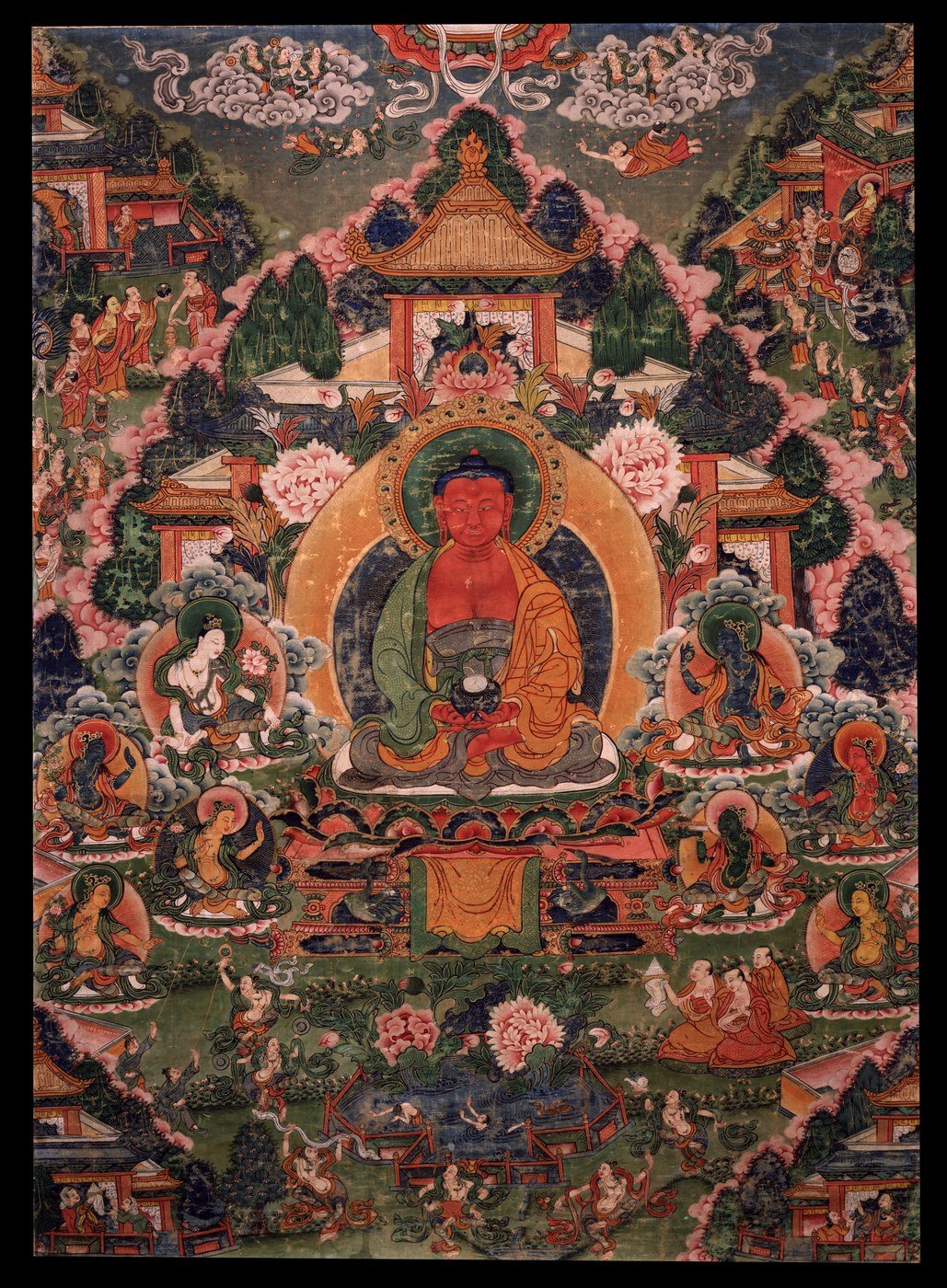
And the tradition insists the body itself keeps the score. After sincere practice the crown is said to soften, to itch, to swell, and sometimes to weep a single bead of serum or blood at the exact center of the vertex — and a lama tests it by standing a stalk of kusha grass upright in the opening.31 The masters even grade the practice: Patrul Rinpoche names five kinds, the highest a transference straight into the formless "body of truth," the lower kinds carrying the dying toward a pure land — and they hold that a consciousness which exits cleanly through the crown can bypass the perilous after-death passage, the bardo, altogether. I owe you full honesty about what this is: it is a Buddhist practice, aimed at a Buddhist liberation, and its theology is not mine — I am not asking you to take it up. But look at what it assumes, with complete matter-of-factness, as the plain blueprint of a human being: that consciousness is a point of light; that it lives in a channel up the center of you; that the one good door out is the crown; and that on the far side of that door is Boundless Light. An entire civilization built a science of dying on the exact claim this paper is making — that the summit of the head is the doorway, and the Light is on the other side.
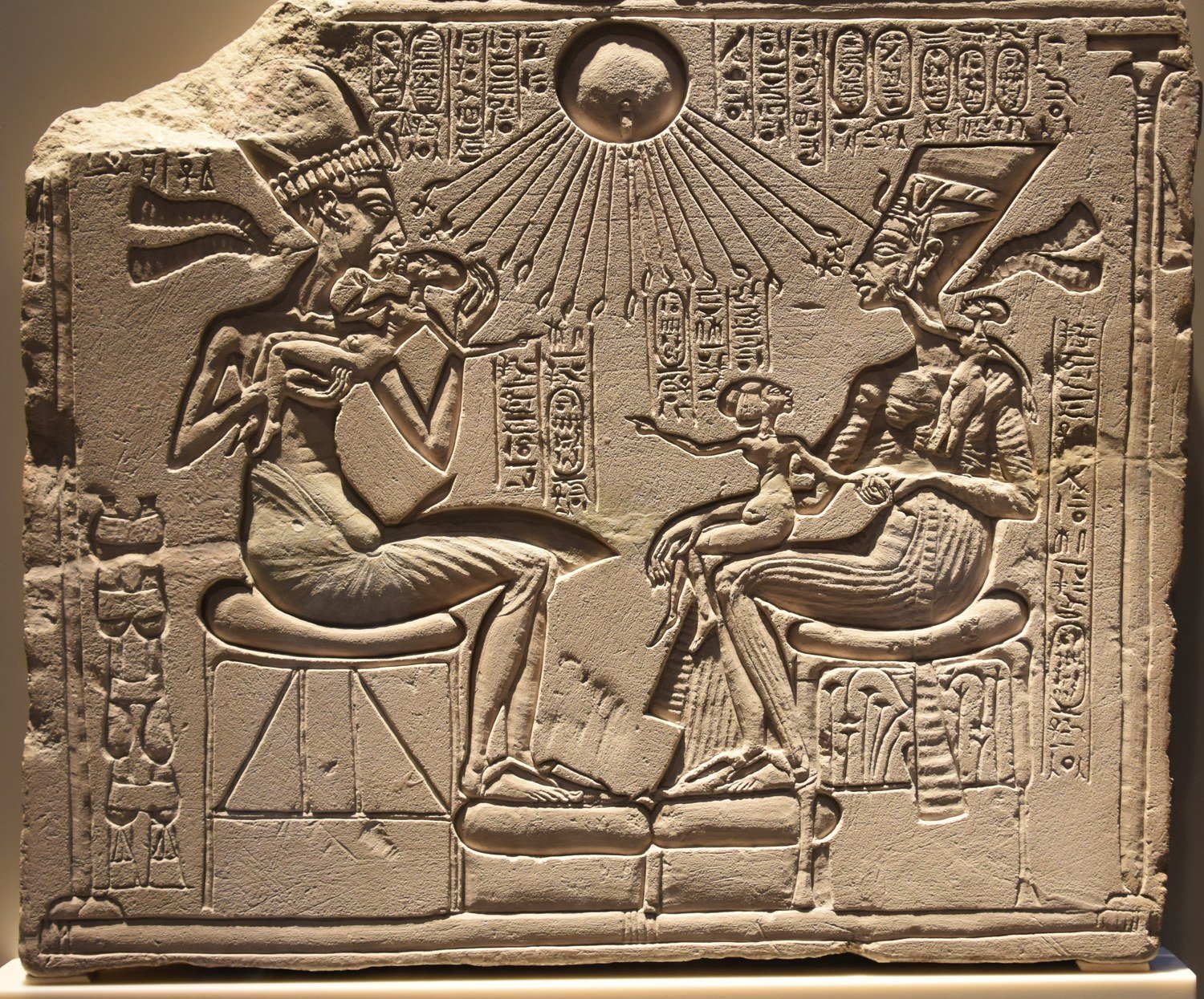
In Egypt, in the radical monotheism of Akhenaten, the Aten was depicted as a sun-disk whose rays end in human hands, reaching down to touch the heads of the royal family, some offering the ankh, the sign of life, directly to them.34 This is sun-king iconography, not a chakra, and I will not call it one — but the image is unmistakable: divine light descending as rays onto the crowned head.
And everywhere — Christian icons, Buddhist aureoles, the coins of god-emperors, along the Silk Road in every direction — humanity drew the same thing around the heads of its holy ones: the halo, the nimbus, the disk of light at the crown.35 It is the single most universal piece of religious art on earth, and it is, in every culture, a crown of light above the head. The artists did not all conspire. They were all drawing the same observed or intuited reality.
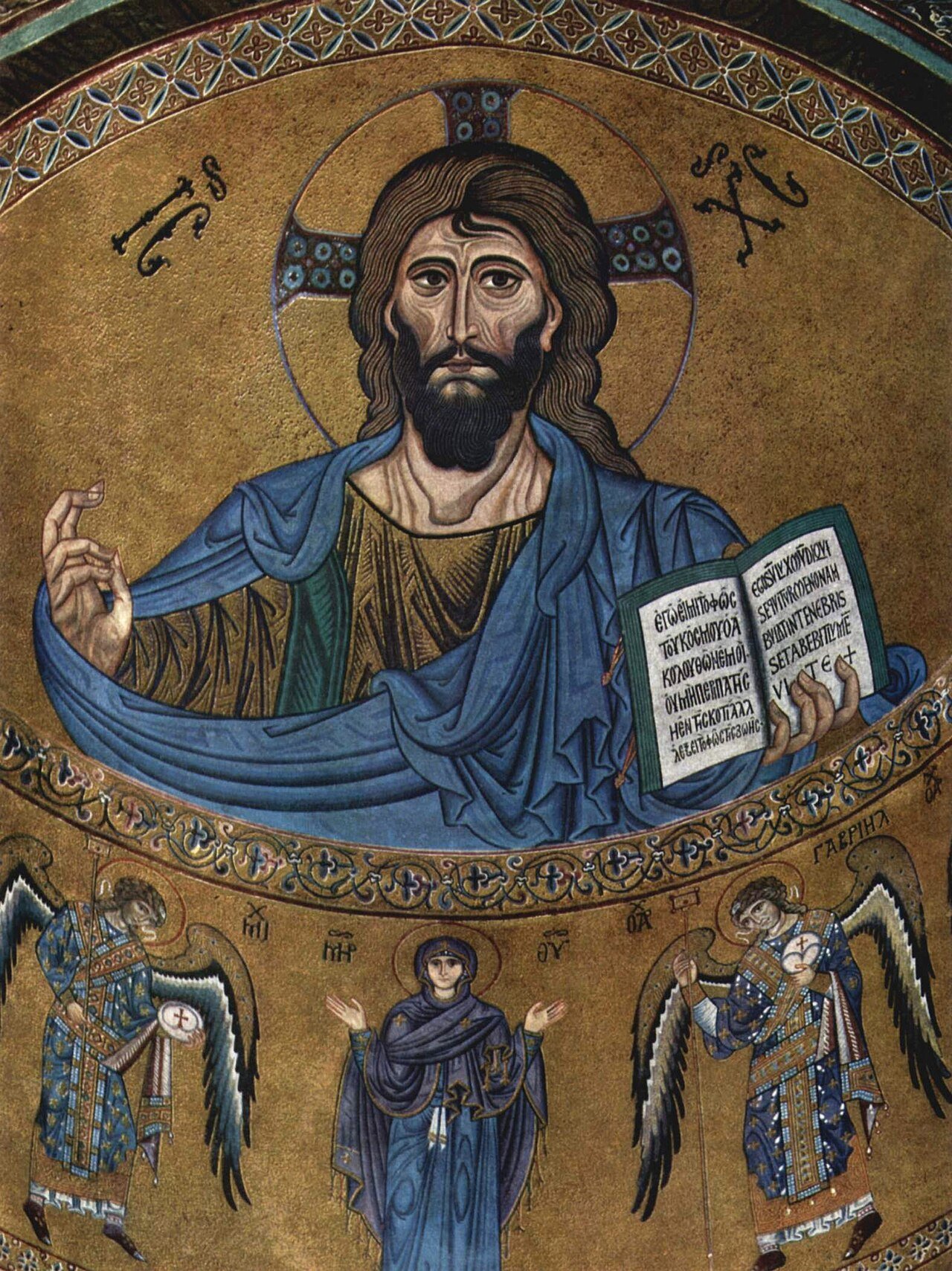
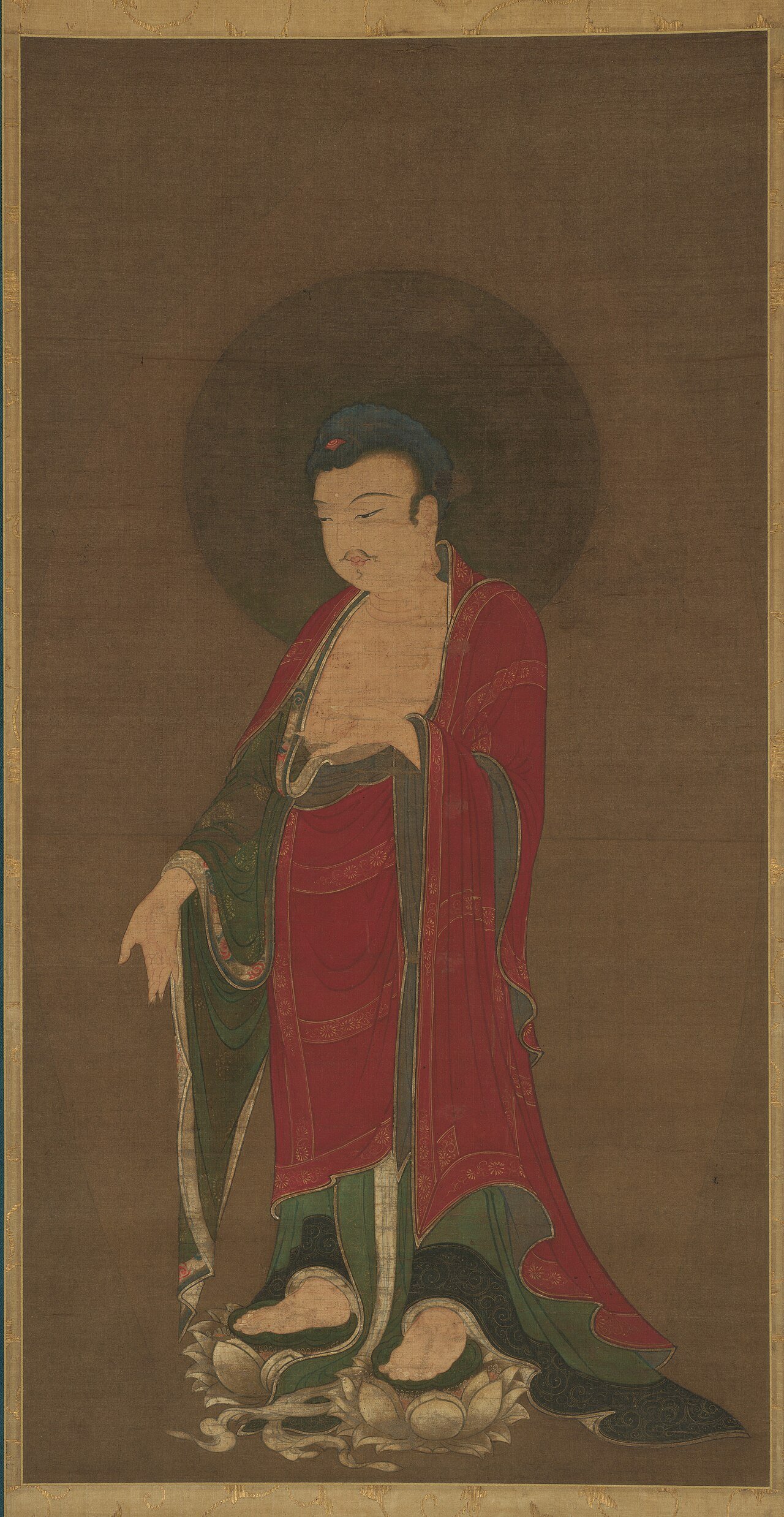
And the marking of that one point did not stay in the distant past, or only in the East. For some fifteen hundred years Christian monks shaved the crown of the head into a bare ring — the corona, the "crown" — and the medieval Church said plainly that it was worn in imitation of Christ's crown of thorns: the same square inch of skull, marked on purpose, by the Church itself.67 The Jewish man at prayer binds the tefillin, the little box of Scripture, to that same place at the hairline above the brow.67 The Sufi traditions map a hidden, "most-arcane" center, the akhfa, at the crown of the head.67 And there is an anatomy under all of it that every parent has touched: every newborn child comes into the world with the crown of the skull literally open — the soft spot, the fontanelle — an aperture at the exact point the yogis call the Brahmarandhra and the Kabbalah calls Keter, which only later closes over with bone.67 The body itself is built with the door, and seals it shut as we grow.
I have to make a correction here. There is a popular teaching of a "thirteen-chakra system" with a "Godhead chakra one hand-length above the head," sometimes presented as ancient Egyptian. It is not ancient and not Egyptian. It traces to a modern source — Drunvalo Melchizedek's The Ancient Secret of the Flower of Life, Volume 2 (2000) — which relabeled an Indian concept as "Egyptian."36 And I owe a debt here, so I will pay it openly: Drunvalo's two volumes are where I first learned of the Godhead. I bought them thinking they were books on meditation, and instead they connected a hundred dots I never would have connected on my own. Without those books I would not be writing this today, and I give him full credit for that. I do not hold him up as Scripture — much of it is far out there, and I tell every reader to question everything and do your own research — but there is real knowledge in his work, and it opened my eyes. A genuine shout-out to Drunvalo, with that caveat firmly attached.
Strip away the labels and one structure stands in all of them: a point at or just above the crown, where divine light enters and the soul departs, drawn as a disk of radiance, named as a crown. So where did it come from? Who "invented" it? I think the honest answer is that no one did — it is too old and too widespread to have a single inventor. It surfaces independently in Egypt's solar theology, in the throne-visions of Israel (§VI), in the Vedic and Tantric body-maps, in the Tibetan death-rites — as if every culture that looked inward for long enough found the same door. The Kabbalah did not invent it. The Kabbalah named it most precisely — Keter, the Crown, the doorway of the Infinite Light — and gave it the thorn. And precisely because it named it so precisely, it then sealed it away, which is where the trouble starts, and where I am headed in §IX.
VI. The Light Teachings — Thomas, Enoch, and the Ancient of Days
The written inheritance speaks the same language, in texts the centuries treated very differently. The Gospel of Thomas, recovered from the sands of Nag Hammadi in Egypt in 1945, is a collection of sayings attributed to Jesus — a real, ancient text whose dating scholars debate and whose authorship is not the apostle's, but which several serious scholars believe preserves an early, independent stream of Jesus' words.24 I take its teaching seriously, and it is saturated with light at the center of the human being. In the Lambdin translation:
"There is light within a man of light, and he lights up the whole world. If he does not shine, he is darkness."— Gospel of Thomas, Logion 24
"If they say to you, 'Where did you come from?', say to them, 'We came from the light, the place where the light came into being on its own accord…'"— Gospel of Thomas, Logion 50
"It is I who am the light which is above them all. It is I who am the all… Split a piece of wood, and I am there. Lift up the stone, and you will find me there."— Gospel of Thomas, Logion 77
"…the kingdom is inside of you, and it is outside of you. When you come to know yourselves, then you will become known…"— Gospel of Thomas, Logion 3
Logion 3 speaks volumes to me. The kingdom is inside you and outside you, and the key is to know yourself — to know that you are not your body, you are a soul, and your soul carries the Holy Spirit. That single line carries the whole message of this paper.
Behind the Gospels stands the visionary literature of Israel. The Book of Enoch (1 Enoch) — pseudepigrapha, canonical only in the Ethiopian church, but quoted as prophecy in the New Testament Epistle of Jude (14–15), and found among the Dead Sea Scrolls — records a throne-room vision that prefigures everything:
"…I saw therein a lofty throne: its appearance was as crystal, and the wheels thereof as the shining sun… And the Great Glory sat thereon, and His raiment shone more brightly than the sun and was whiter than any snow."— 1 Enoch 14:18–20 (R.H. Charles translation)
Wheels. Fire. Raiment whiter than snow. And in the Similitudes, the Head of Days: "His head was white like wool," beside whom stands "another… whose countenance had the appearance of a man," the Son of Man, named before sun and stars were made (1 Enoch 46, 48).25 That image did not stay in Enoch. It is Daniel's vision exactly:
"…the Ancient of Days took His seat; His clothing was white as snow, and the hair of His head like pure wool; His throne was fiery flames; its wheels were burning fire."— Daniel 7:9 (ESV)
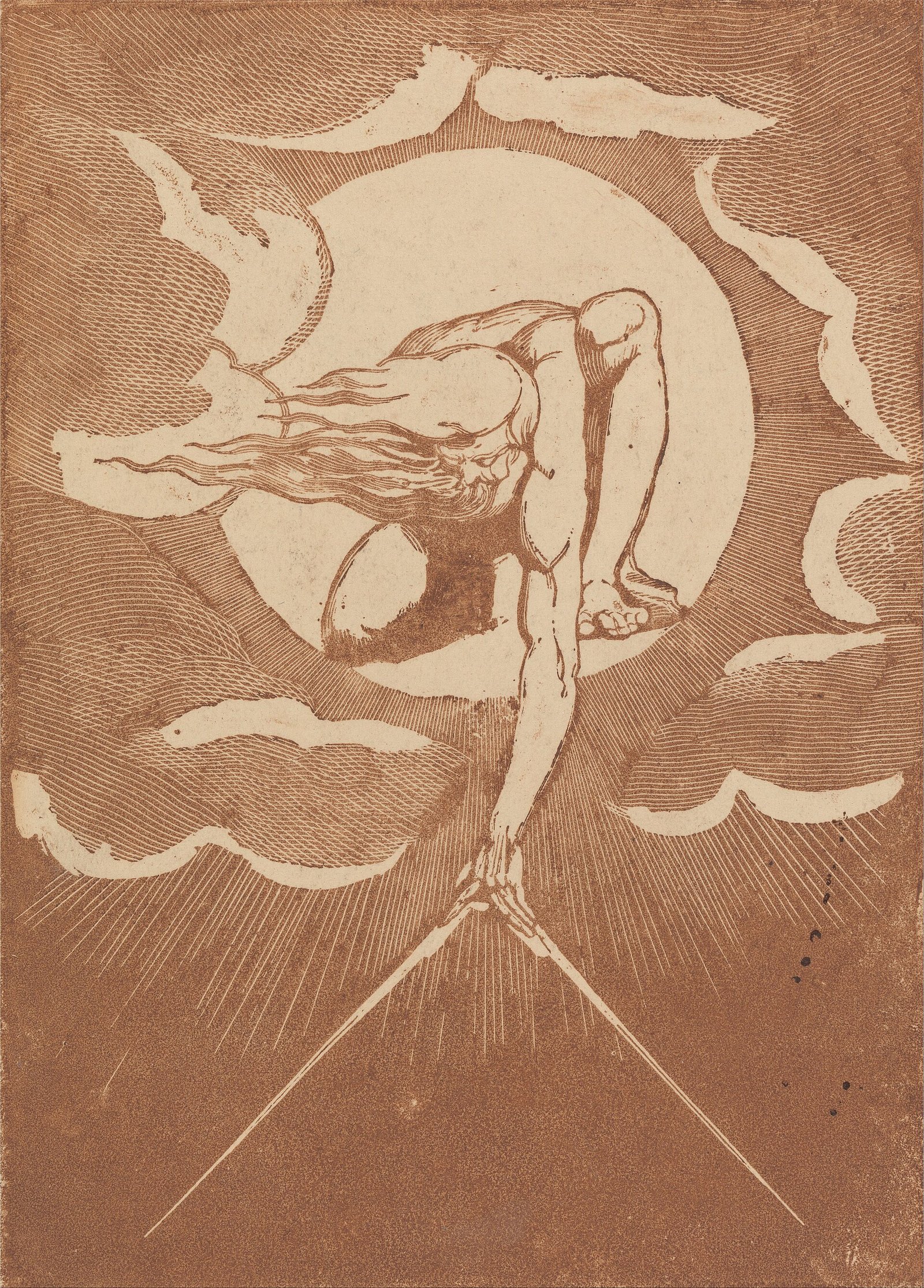
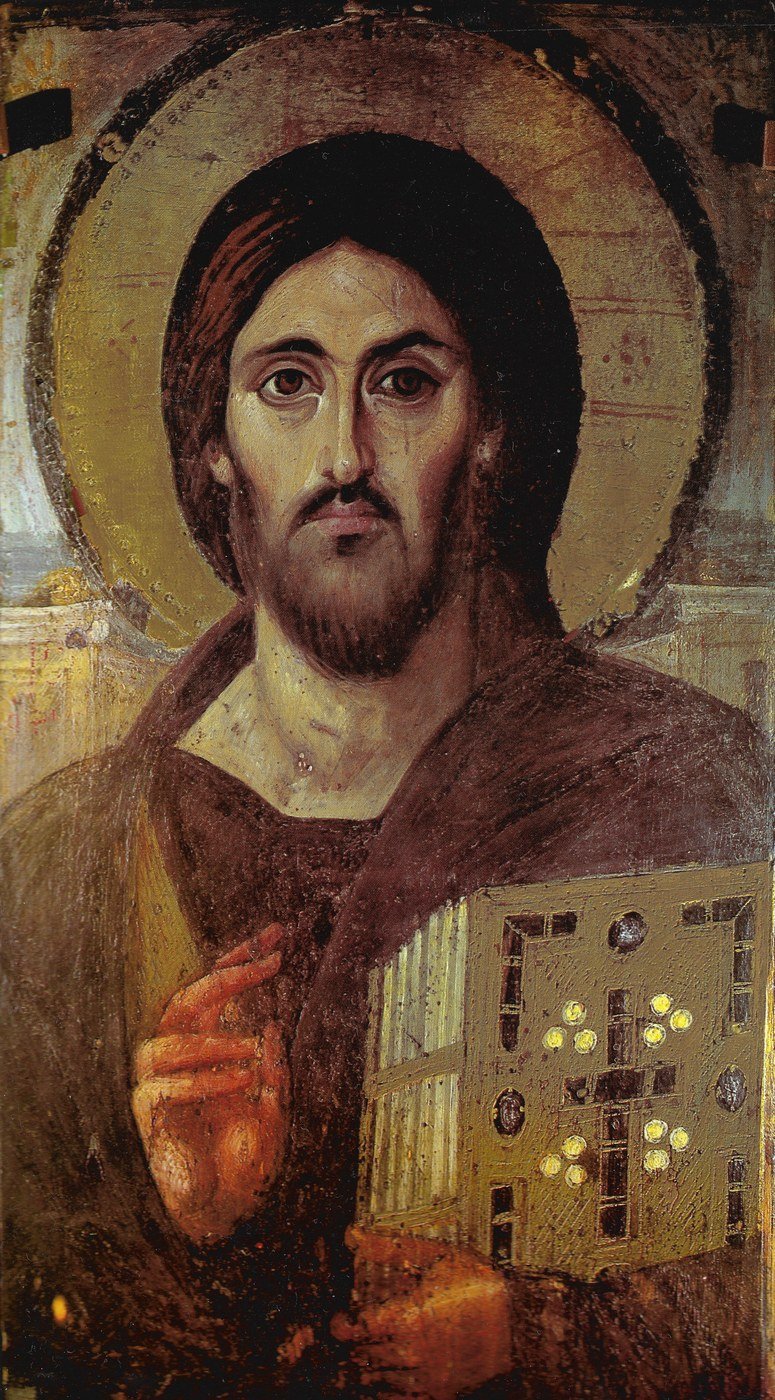
And it is Revelation's risen Christ: "The hairs of His head were white, like white wool, like snow… and His face was like the sun shining in full strength" (Revelation 1:14–16).26 White as wool. White as snow. Fire and wheels. The same radiance, the same words, across a thousand years of text.
And the crown of light is not only something seen in vision; Scripture shows it given. When Moses came down from meeting God on the mountain, the skin of his face shone so brightly that he had to veil it (Exodus 34:29–35) — the Hebrew is qaran, "to send out rays": light at the very head of the man who had stood in the Presence.26 And at Pentecost, when the Spirit was poured out on the whole Church at once, "there appeared unto them cloven tongues like as of fire, and it sat upon each of them" (Acts 2:3) — a flame resting above every head in the room.26 What Daniel saw enthroned, and what the icon-painters drew in gold, the Church received as fire on the crown.
And here the two streams I have been tracing — the Jewish and the Christian, the mystical and the canonical — flow into one channel, and this is the seam I believe in most strongly, so I want to press on it. The Zohar, in its most esoteric passages, the Idrot (its most secret, hidden chapters), identifies the Ancient of Days of Daniel's vision — Atik Yomin, the Ancient of Days, whom the Idrot also name Atika Kadisha, the Holy Ancient One — with Keter itself: the highest emanation, the Crown, the white-fire interface of the Infinite.23,19,21 This is not a stray association. In the Zohar's account, the Ancient of Days is the very face of Keter turned toward creation — the "long face," Arikh Anpin, of boundless patience and mercy, the innermost persona of the Crown. So when Daniel lifts his eyes and sees an ancient figure, white as wool, enthroned in wheeling fire, he is not seeing an old man on a chair. In the reading of Israel's own mystics, Daniel was seeing Keter. He was seeing the Crown of God manifest at the very edge of what a human being can perceive — the white-haired radiance, the fiery wheels, the doorway of the Infinite turned outward into vision.
And the Christian completes the circle without knowing he is closing a Kabbalistic loop: Revelation gives the risen Christ the identical description — white hair, white as snow, face like the sun. The text is saying, in the plainest available terms, that what Daniel saw as Keter, John saw as the glorified Jesus. The Crown of God and the face of the risen Christ are painted in the same handful of words. The Ancient of Days, the Keter, the white-fire Crown — and the man from the cloth, raised — are, when you lay these texts together, one radiance.
The wheels of Daniel's throne. The energy vortex above the head. The First Swirlings of the Hermetic crown. The wheels-within-wheels of Ezekiel's chariot, "gleaming like beryl… a wheel within a wheel," the radiant figure above them ringed "like the appearance of the bow that is in the cloud" (Ezekiel 1:16, 26–28).26 The mystics kept drawing wheels and swirls and spinning fire at the place where the divine meets the head. And nineteen centuries later, a lawyer's photographic plate resolves a structured disturbance at the crown of a crucified man.
VII. The Light Above the Head, Drawn in the Modern Age
I want to give you one more witness, recent enough that we can name the people who drew it. In the 1930s, Guy Ballard, writing as "Godfré Ray King," founded the "I AM" Activity, teaching the Mighty I AM Presence.28 Set aside where his teaching came from. Look only at what he drew. The central image is the "Chart of the Presence": a human figure below, and directly above the head, a blazing sphere of white light — the individualized God-Presence — ringed by concentric bands of colored light. And connecting figure to Presence: a Tube of Light, a column of white fire descending from above the head through the crown to surround the person.28
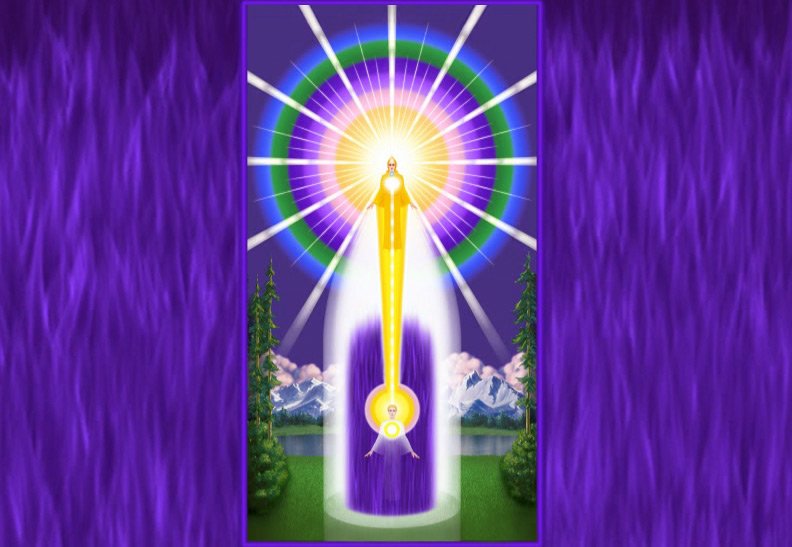
A blazing white light, above the head. A column of fire descending through the crown. Drawn in Chicago in the 1930s by people who had, in all likelihood, never read the Zohar's account of Keter, and certainly never read a Shroud radiation paper that would not exist for another fifty years. This is explicitly a twentieth-century movement, rooted in Theosophy and New Thought — not ancient, and I say so without flinching.28 Its value is not antiquity. Its value is independence. Another human being, another century, another idiom, closed his eyes, attended to the divine, and drew a column of white light descending through the crown from a radiant Presence above it. The same structure. Again. The convergence is most powerful precisely because none of these witnesses copied another.
The name Ballard gave the Presence is the oldest name of all. When Moses asked God for a name at the burning bush, the answer was Ehyeh Asher Ehyeh — "I AM THAT I AM" (Exodus 3:14).39 Some thirty centuries later the philosopher would grope toward the same ground from the other direction — cogito, ergo sum, "I think, therefore I am" — Descartes finding that the one thing that cannot be doubted is one's own awareness of one's own existence — the bare certainty that I am, and that I know I am. The mystic and the philosopher arrive at the same bedrock from opposite roads: strip away everything, and what remains at the summit of a human being is simply Being itself, aware of itself. I AM. It is the name of God, and it is the floor of your own consciousness, and what I am claiming is that they meet at the crown.
VIII. The Unified Picture
Let me lay it all on one table.
The physicists and the forensic doctors, bound to their instruments, found the wounds of the Passion written in real blood, an image no one can reproduce formed by something that behaves like a vertical burst of light, the blood laid down before the image, a structured absence at the top of the head, and a coloration that sits on the surface like radiance rather than pigment.1,2,6,7,46 One of their own went as far as the Uncreated Light and stopped.8
The Kabbalists, eight centuries earlier and with no instrument but contemplation, placed the Infinite Light at a Crown above the head, called it the doorway where the boundless becomes a point, described it as a hidden white radiance the eye cannot hold, and — most precisely of all — wrote that Crown as a thorn.14,15
The Romans, intending mockery, pressed a cap of thorns — the very emblem of Eden's curse — onto the exact anatomical point the Kabbalists called the Crown, driving the tradition's own symbol of the Godhead, and the sign of the Fall, into one bleeding point.45,54
And every other tradition that ever looked — Vedic, Tibetan, Egyptian, the icon-painters of three continents, and a man in 1930s Chicago — drew the same thing at the same place: light above the head, a column through the crown, a disk of radiance, a wheel of fire, a doorway between worlds.
Here is what I believe, offered as my synthesis and not as proof, with the seam fully visible:
At the moment His followers called the Resurrection, the man in the cloth underwent the event every one of these traditions describes from its own doorway — the full opening of the Crown, the complete union of the finite form with the Infinite Light, Keter blazing wide, the Ein Sof touching the world through the one point built to receive it. The energy of that union released along the body's vertical axis — up and down, as the physicists' geometry requires — and the linen, lying over and under Him, recorded the imprint. It recorded a front and a back, because that is where the cloth was. It recorded nothing at the top of the head, because that was not where the cloth was — that was where the Light was going: straight up, out through the Crown, through the thorn, into the Infinite. The gap above the head is not missing data. It is the photograph of the doorway. It is the Ein Sof touching the world, caught in the only place a cloth could not be: the open Crown itself.
And now let me rise to meet the thing I am describing, because this last part cannot be said in the flat voice of a footnote.
Consider what we are actually looking at. A hostile physicist with no use for God, and a medieval mystic bent over the Zohar by candlelight. A Tibetan adept at a deathbed, standing a blade of grass in a dying man's softened skull, and a sun-priest on the Nile lifting his face to a disk of rays. An icon-painter grinding gold for a halo he could not have explained, and a man in a Chicago apartment in 1934 drawing a tube of white fire above a human head. They never met. They did not share a language, a century, a continent, or a god they could agree to name. And every single one of them pointed at the same hand's breadth of space above the human skull and said, each in his own tongue: here — here is where the divine enters; here is the door. Across five thousand years and ten thousand miles — and I do not need to prove that not one of these streams ever touched another; some did, and the halo itself spread from culture to culture — the testimony still does not waver, because diffusion cannot explain a pattern this wide: the same point, above the same head, across languages, continents, and gods that share no story. The crown. Always the crown. And then — once, on one night, in one tomb — that door is said to have been thrown all the way open, and a piece of cloth was lying there to catch what came through. And when, eighteen centuries later, a man in a darkroom inverted the image and the face leapt out of the negative at him, there above the head, in the one place the prophets and the yogis and the painters had all been pointing, was a structured mark no one has ever explained. The convergence is the evidence. Not any single thread, but the impossible agreement of all of them — the fact that humanity, asked across all its ages and all its altars where God touches a human being, has only ever given one answer, and that the answer is written, faintly, in light and blood, above the head of the man in the Shroud.
This is why I cannot let it go. It is not one clue. It is all of them, agreeing. And the agreement is too perfect, too old, too widespread to be an accident of the human imagination. I believe it is agreement because it is true — because there really is a door at the top of your head, and the Light really does come through it, and one Man opened it all the way and left us the proof. My full testimony comes at the end of this paper. But first I have to answer the question I know you are asking: if this is real, why has no one told you?
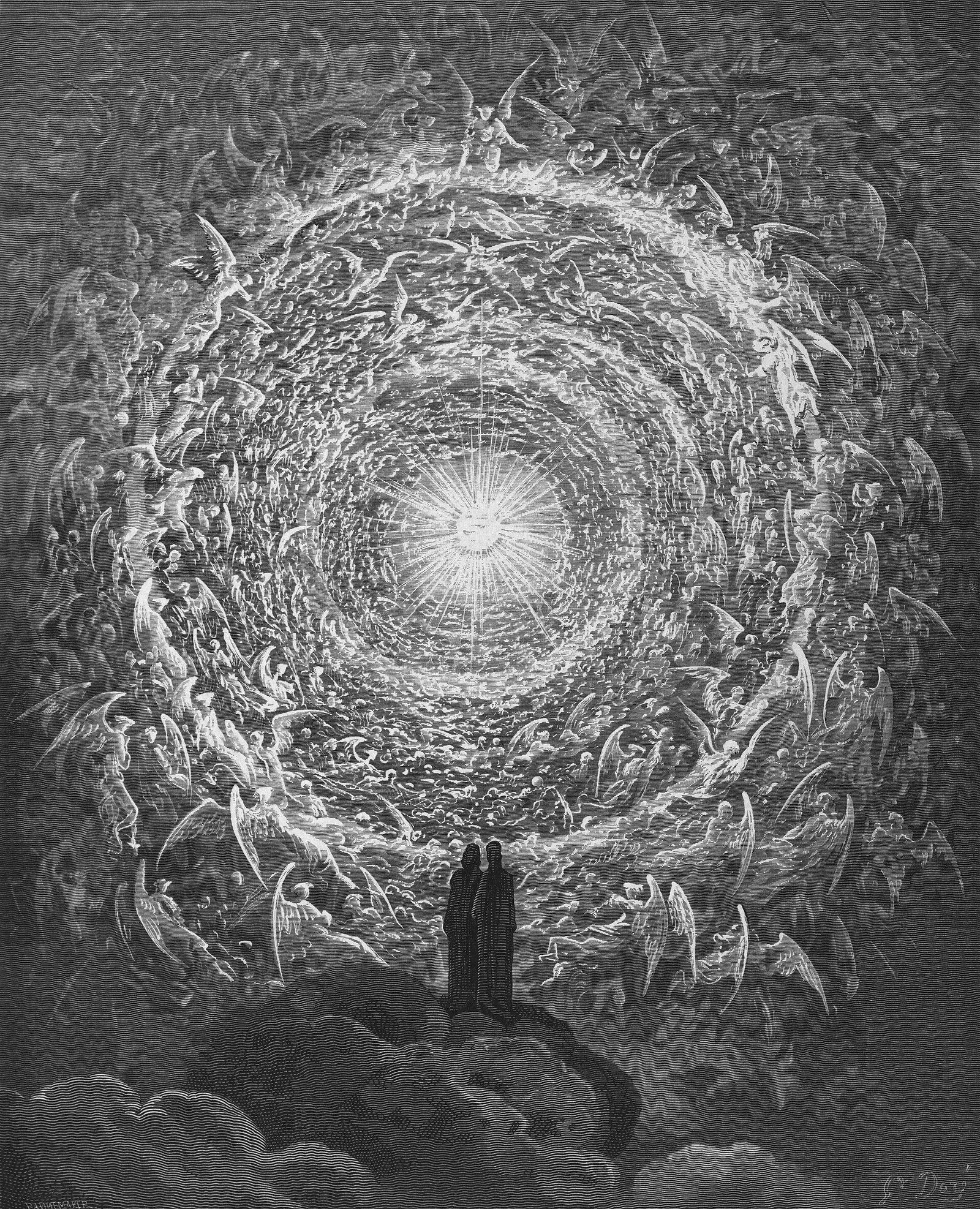
IX. The Hidden Knowledge — Why You Were Not Told
If all of this is real, why is it not at the center of the faith most of us were handed? Why does the Bible most people own contain no Book of Enoch, no Gospel of Thomas, no map of the Crown?
I am going to answer that in three layers, and they stack — from what I can prove, to what I believe, to what I hope. Hold me to the first layer especially, because none of it depends on taking my word for anything.
Layer one: the documented machinery of power
Start with what can be proven, because it is damning enough on its own. Across history, sacred and esoteric knowledge has been gatekept by those who held power — and this is not conspiracy theory, it is the ordinary, footnoted record.
Begin with the texts themselves. The canon was selected. The collection most Christians call the Bible is the result of a long process of choosing, in which an emerging church-and-empire authority included some books and excluded others. The Book of Enoch — quoted as prophecy in Jude itself25 — survived as scripture only in the Ethiopian church and was let go everywhere else. The Gospel of Thomas, with its insistence that "the kingdom is inside of you," was not merely omitted but actively buried: the Nag Hammadi codices were hidden in a jar in the Egyptian desert, most likely by monks protecting them from destruction after such books were ordered suppressed, and they did not surface again until a farmer dug them up in 1945.24 And on the Jewish side, the deepest material was placed under guard by Judaism's own law: the Mishnah rules that the throne-vision mysticism — the Ma'aseh Merkavah, the very vision of Ezekiel and Daniel I have been tracing — may not be taught in public, may not be taught to more than one student at a time, and may be opened only "to one who is wise and understands of his own knowledge," and then only in chapter-headings, orally.17 The map of the Crown was real, and it was deliberately sealed.
Now follow the power, because this is where the timeline I want you to see comes together. When the Western Roman Empire fell in 476, the authority did not vanish into thin air — it migrated. Into the vacuum stepped the bishops of Rome; Leo the Great asserted Rome's primacy, Gregory the Great governed the city in fact as well as in faith, and in 756 the Frankish king Pepin handed conquered Italian lands to the pope, creating the Papal States and formal papal temporal rule — a sovereignty that ran unbroken until 1870 and was re-established as Vatican City by the Lateran Treaty of 1929.60 Rome did not so much fall as change its vestments. The empire that had crucified Christ became the institution that would, for over a thousand years, decide what the masses were permitted to read about him.
And part of that authority was built on a forgery. For six centuries the popes leaned on the Donation of Constantine — a document claiming the Emperor Constantine had granted the See of Rome temporal dominion over the Western Empire — to justify their earthly power. It was fake. It was fabricated, most likely in the eighth century, and the Renaissance scholar Lorenzo Valla proved it a forgery in 1440 by the simple fact that it used Latin words that did not exist in Constantine's time.58 Sit with that: the power that would decide which gospels you were allowed to hold rested, in part, on a document it had forged. On top of that fabricated foundation the claims only grew — in 1302 the bull Unam Sanctam declared that "it is altogether necessary to salvation for every human creature to be subject to the Roman Pontiff."59 Submission was no longer political. It was made a condition of your soul.
And here is the part that should make every honest reader's blood run cold, because it is the most documented of all and it goes straight to the heart of my thesis. They kept the Word itself away from you. Scripture was locked in Latin, a language the common person could not read, while lay possession of the Bible was restricted — the Council of Toulouse moved against laypeople owning the Scriptures in 1229 (a regional measure, I will be precise, not a universal one, but a measure all the same).61 And when brave men tried to put the Word into the language of ordinary people, they were killed for it. John Wycliffe dared to translate the Bible into English; decades after his death the Church had his bones dug up and burned and his ashes thrown in a river (1428). Jan Hus, who carried his ideas, was burned alive at the stake in 1415. William Tyndale, whose English translation underlies the very King James Bible millions read today, was strangled and burned at the stake in 1536 — for the crime of translation.62 Let that land, because it is the plainest proof I can put in front of you: men were burned alive for trying to give you the Bible in a language you could understand. And for four centuries — from 1559 until it was finally abolished in 1966 — the Church maintained an official, named list of books the faithful were forbidden to read, the Index Librorum Prohibitorum.63
That is not a feeling. That is the record. The knowledge that frees people has always been inconvenient to the people who would rule them, and the suppression of the inner Light is the oldest case study of that rule there is. The monopoly did not break until 1450, when Gutenberg's printing press collapsed the cost of a book and put Scripture into common hands — and it is no accident that the Reformation, the first mass escape from that gatekeeping, followed the press within two generations.64 They could burn a translator. They could not burn a printing press.
Now, I have to be honest with you about the threads I chased that did not hold, because I would rather you trust me on the things that did. There are darker, more dramatic claims that circulate — that the Cestui Que Vie Act of 1666 secretly declared us all legally dead and made us property of the Crown or the Vatican, planned in advance by a hidden document centuries earlier. I went looking. The 1666 Act is real — I read it — but it is a dry piece of English property law about land held for the duration of a person's life, and the courts have flatly rejected the "we were all declared legally dead" reading as pseudo-law.65 And the supposed master-plan document behind it, the one people date to the 1300s, has no archival basis at all; it traces to modern self-published lore, not to the historical record. So I will not hang my case on those, and you should not either. I do not need them. I would rather stand on a forged Donation, a burned Tyndale, and a four-hundred-year list of forbidden books — things no skeptic can take away from me — than on a claim a single careful reader could dismantle in a sentence. The documented spine is damning enough.
Layer two: the spiritual war behind the worldly power
Now I move from what I can prove to what I believe — and I am marking the line on purpose. Because when I look at that whole timeline — the forgery, the burnings, the sealed mysteries, the list of forbidden books, century after century, empire after empire — I do not think I am looking at the work of men alone.
Could it be one long conspiracy of men, running for a thousand years to keep the truth from us? Honestly, I think that is too much for men. Men are not that consistent, not that patient across the centuries — and the ones who traffic in the lowest, cruelest things are, by the very vibration they operate in, too low to sustain anything that vast. So I do not believe this is merely men. I believe it is bigger than man.
Scripture says so plainly. "We do not wrestle against flesh and blood, but against the rulers, against the authorities, against the cosmic powers over this present darkness, against the spiritual forces of evil in the heavenly places" (Ephesians 6:12).55 "The god of this world has blinded the minds of the unbelievers, to keep them from seeing the light of the gospel of the glory of Christ" (2 Corinthians 4:4).55 The adversary is "a liar and the father of lies" (John 8:44), and "the whole world lies in the power of the evil one" (1 John 5:19).55 The Bible does not present the obscuring of divine truth as an accident of committee politics. It presents it as strategy — the deliberate work of an intelligence that blinds minds precisely "to keep them from seeing the light."
And the Book of Enoch tells me how that strategy began. The Watchers — rebellious angels — came down, and their crime was not only lust; it was the corruption of knowledge. "Azazel taught men to make swords, and knives, and shields, and breastplates… and the use of antimony, and the beautifying of the eyelids… Semjaza taught enchantments… astrology… the constellations" (1 Enoch 8), and the verdict was: "the whole earth has been corrupted through the works that were taught by Azazel" (1 Enoch 10:8).53 The oldest account we possess of how truth went wrong is an account of spiritual beings teaching corrupted knowledge to mankind. Hiding the true Light and teaching false light are, in Enoch, the same ancient operation.
I am a man of God, a reverend, and I believe the Book of Enoch. I believe the fallen angels are real, that demons are real, that Satan is real, and that they have had both the knowledge and the time — the patience of the ages — to hide the truth from us, to manipulate what we read and what we are taught, and to work through whatever worldly powers would serve them. After everything that has come to light in recent years, I do not think it is a stretch to say that most of what reaches our eyes flows through a narrowing channel of a very few hands. Too much has been uncovered. A lot of us have woken up. And what we have woken up to is not only a media story or a political one — it is a spiritual battle, the real war Scripture warned of, and it is happening right now. When I was a child in the 1980s I was warned about the enemy's plan and what the world would become, and I rolled my eyes. They were right. I have watched what they predicted come to pass in my own lifetime. So here is the way I want you to hold the two layers together: the worldly power is real, and you can document it — the forgery, the burnings, the banned books are not in question. But the worldly power is the evidence of the spiritual war, not its cause. Follow the worldly power far enough back and you find the principalities standing behind it. That is the whole point.
Layer three: and yet — the timing may be mercy
There is a third possibility, and it is the most hopeful, and I hold it right alongside the second rather than instead of it.
If all things were created by God, then even this long obscuring sits, somehow, inside His design — and maybe the knowledge was kept sealed not only because the adversary hid it, but because we were not ready to hold it. Power in unprepared, unloving hands is ruin; that is the very reason the Mishnah sealed the Merkavah teaching in the first place.17 Maybe the door stayed shut until enough of us could be trusted to walk through it in love instead of pride. Maybe the unveiling is on a clock, and the clock is now.
Either way, the response I am calling for is the same, and it is restoration, not accusation. My ministry is called Messages to the Masses Ministry, and the work is to carry back to the masses exactly what the masses were not given — not to indict any people, but to restore what was taken. The villain of this chapter is not a bloodline or a nation; it is the adversary Scripture names, working through the timeless machinery of worldly power. And the answer to that adversary is not hatred — hatred is his own frequency, and it only feeds him. The answer is the Light itself, handed freely back to everyone he tried to keep it from.
X. The Practical Path — Opening the Crown
A map of a door is worth little if no one walks through it. Every tradition that named the Crown also taught a way to approach it — and remarkably, when a Harvard scientist stripped those ways down to their common core, what was left was simple enough for anyone.
First, the science of stillness — Dr. Herbert Benson
In the early 1970s a Harvard cardiologist named Dr. Herbert Benson noticed that his patients' blood pressure rose and fell with their stress, and went looking for the off-switch. He began with practitioners of meditation, who volunteered to be measured, and in them he documented a reliable physiological shift he named the Relaxation Response — lowered blood pressure, a slowed heart and breath, dropped oxygen consumption and metabolism — the exact opposite of the body's fight-or-flight stress reaction.51 Then his curiosity carried him toward the most extreme meditators on earth. He had read the old travelers' accounts of Tibetan monks who could raise their body heat by inner fire, and he wanted to measure it for himself. He asked — and the first answer was no. When he made the request through the Dalai Lama in 1979, His Holiness turned him down, saying these were private spiritual practices, not exhibitions for science. Months later the Dalai Lama relented, and Benson became the first Western scientist permitted to study the monks at close hand. In 1981, in the Himalayas above Dharamsala, he got his measurements: practicing g-tum-mo ("inner fire"), the monks raised the temperature of their fingers and toes by as much as 8.3°C — about fifteen degrees Fahrenheit — through meditation alone, a result he published in Nature in 1982; later researchers would show that the most advanced practitioners can drive even their core body temperature up toward a low fever.51 So when I tell you the inner state reaches down and moves the body, this is not poetry. It was measured at Harvard.
Then he did the thing that matters most to me: he studied the meditative and prayer techniques of many religions, looking for what they all had in common. In his first and most famous book, The Relaxation Response (1975), he distilled that common core into four basic elements — and these four are the doorway, the place anyone can begin tonight:51
A quiet place
Minimize distraction and interruption. Even a corner will do.
A comfortable position
Sit so the body can be still without strain. Spine easy and upright.
A mental device
A single word, phrase, sound, or short prayer, repeated silently; the anchor that quiets the restless mind.
A passive attitude
And this is the heart of it. When thoughts intrude (they will), do not fight them or grade yourself. Notice, release, and return gently to the word. Do not try to relax; allow it.
But four is only where he began, and because I have read his later books I want to give you the fuller picture he arrived at — it corrects a thing I once held too simply. In Beyond the Relaxation Response (1984) Benson added what he called the Faith Factor: he found that when the repeated word is drawn from your own deepest belief — for a Christian, the name of Jesus, or a line of a psalm — the effect runs deeper than any neutral sound could.51 And in his most recent major book, Relaxation Revolution (2010), he laid the whole thing out in full. At its heart he reduced it to two essential movements — (1) repeat your focus (a word, a phrase, a short prayer, an image, or simply the rhythm of your own breath), and (2) when other thoughts arrive, let them go without judgment and gently return — but he set those two inside a fuller order of steps worth following exactly:51
The steps, in order
- Pick a focus — a word, a short phrase, a prayer, or your own breath.
- Sit quietly in a comfortable position.
- Close your eyes.
- Relax your muscles, slowly, from your feet up to your face.
- Breathe slowly and naturally, silently repeating your focus on each out-breath.
- Keep a passive attitude — when thoughts intrude, let them pass ("oh well") and come back to the focus.
- Continue for ten to twenty minutes.
- Practice it once or twice a day.
That is the whole foundation. Meditation feels impossible right up until you actually start, and then one day it isn't — you learn to slip into stillness almost at will. I will give credit where it is due: Dr. Herbert Benson's books are the most accessible, most scientifically grounded on-ramp there is, and they are where I first learned to truly quiet my mind.51 Begin there. Everything that follows is a deepening of that same simple practice.
And here is what I believe Benson's instruments could not measure. When you quiet all of it — when you still every thought, when you shut off the chaos and reach the top of the head — that is the point where you can touch the divine. Not leave your body; the opposite. You go inward and upward to the Holy Spirit that is already within you, and you find it is your direct line to God. I believe this is tapping into the same Source and the same faith Jesus drew on to walk on water. It is not channeling spirits and it is not astral wandering. It is coming home to the One who already lives in you. And I am convinced you can only truly reach it from the higher frequencies — from love. You cannot get there carrying hatred, fear, or doubt. You get there in faith and in love, or you do not get there at all.
Let me stay on that turn — inward and upward — because it is the hinge of everything, and people mistake it constantly, and the mistake matters. The world sells a counterfeit of this: leave your body, throw your mind out across the room or up to some far astral plane, go chasing experiences and sights. That is the exact opposite of what I am describing, and I want to be careful with you, because I believe the counterfeit is a snare. You are not going out. You are going in — past the noise, past the running commentary of the mind, past even the sense of trying — until you reach the still center where the Holy Spirit already lives. And only from there do you go up: not by leaving the body, but by surrender, letting that indwelling Spirit lift your attention to the open crown and through it toward God. It is the most intimate thing there is — not an expedition away from yourself, but a coming-home to the One who has been living inside you the whole time. The deeper in you go, the higher up you arrive. That is not a contradiction; it is the secret of the whole path. This is the Source of the same faith I believe Jesus drew on to walk on water — not borrowed from spirits, not wandered out to in the dark, but found at home, in the indwelling Spirit, in love.
Beyond the first stillness — the long climb upward
I have to be careful not to oversell those four steps, because what Benson's practice gives you is the first stillness — the calm, the lowered storm, the quieted mind. That is the doorway, and it is no small thing; most people never even find it. But every tradition that mapped the Crown is unanimous that the doorway is not the destination, and that past it lies a real ascent — a graded climb that takes patience and, honestly, years. I will not lie to you and say one quiet sitting will carry you to the summit. It is a path, and the path goes upward through stages, frequency by frequency.
The yogis charted that climb most plainly. They describe a ladder of centers — the chakras — strung along the central channel of the body, from the base of the spine all the way up to the crown, and they teach that the awakening energy rises through them one at a time: from the root, through the belly, the heart, the throat, the brow, and at last to the thousand-petaled lotus at the very top of the head — the Sahasrara — where the ascending power is said to meet pure consciousness in union.29 You do not leap from the floor to the roof; you climb, and each rung must be steadied before the next will bear your weight. (Let me be honest, as I have tried to be throughout: the familiar rainbow-colored chart of seven chakras is a twentieth-century Western synthesis laid over much older Sanskrit sources36 — but those older sources truly do describe an ascent up the central channel to the crown, and it is the ascent, not the coloring, that matters here.)
And I carried a memory that the Buddha himself spoke of a graded climb like this — so I went back and checked it, and I want to correct myself honestly where the memory ran ahead of the facts. The Buddha did teach an ascent: a ladder of ever-deeper meditative absorptions, the jhanas, rising stage by stage from ordinary calm up through states so refined the tradition almost runs out of words for them — the sphere of infinite space, of infinite consciousness, of nothingness, and at last a stillness past perception itself. That much is real, and it is precisely the graded inward climb I am describing. But here is the honest correction: the Buddha did not teach that the summit is union with God. He pointed instead to Nibbana, the unconditioned, and was famously wary of naming any creator — so I will not put words in his mouth. What I will say is that the shape of the climb he mapped — consciousness rising through stilled and ever-subtler stages toward a summit — is the same shape every other tradition drew, even as each one names the top of the mountain differently. The Buddhist calls it Nibbana; the yogi, the union at the crown; the Kabbalist, Keter; and I, with everything in me, call it the Holy Spirit and the living God.
I am not handing you a chakra manual or a course in the jhanas, and I am not qualified to. I am telling you the structure is real, and old, and everywhere: there is a floor, and there is a summit, and a way up that goes through stillness, deepening by deepening. Climb it in the company of the Holy Spirit and in the high frequency of love, and you are climbing toward home. Try to climb it for power, or for spectacle, or while carrying hatred, and the door at the top simply will not open — which, as I keep saying, is the mercy built into the whole design.
The Jesus Prayer — the prayer of stillness
This is the Christian contemplative anchor, and it ties directly to Oxley's Uncreated Light.8 Sit still; let the body settle; lower or close the eyes. Repeat, slowly and inwardly: "Lord Jesus Christ, Son of God, have mercy on me, a sinner." Let the words sink from the head into the heart. You may link them to the breath — the first half as you breathe in, the second as you breathe out — but the breath serves the attention, it is not the point. When the mind wanders, return without strain. The aim is hesychia, stillness; the tradition holds that in that stillness, by grace, the heart may perceive the divine Light.37
Approaching by unknowing
Settle into silence. Place every thought, image, and even every pleasant religious idea beneath a "cloud of forgetting." Direct a single naked intention of love toward God, who waits above a "cloud of unknowing" — known by love, not by thought. When thoughts intrude, use one short word — "God," or "love" — not to think about, but to re-aim the heart.38 This is the Christian via negativa (the path of knowing God by what He is not), and it is the structural twin of the Kabbalah's Keter-as-Ayin, the luminous Nothing: you approach the Crown by releasing everything the mind can hold, until only the unknowable Light remains.
The Name — Ehyeh Asher Ehyeh
From the Jewish contemplative tradition, as taught by Aryeh Kaplan.39 Sit quietly; relax body and breath. Take the divine Name of the burning bush — Ehyeh, "I Shall Be," or the full Ehyeh Asher Ehyeh, "I AM THAT I AM" (Exodus 3:14) — and hold it as the single center of awareness. Speak it aloud, then softer, then silently within, until the meaning — pure Being, aware of itself — fills the field of attention. When you drift, return to the Name. It is the same I AM that stands above the head in every Chart of the Presence; here you do not summon it, you consent to it.
Bhramari — to feel the vibration at the crown
From the Hatha Yoga Pradipika.40 Sit comfortably, spine upright. Optionally rest the thumbs gently over the ears. Breathe in through the nose; breathe out slowly making a steady, low humming sound, and feel the vibration travel up into the skull and toward the crown. Several slow rounds. The text says it brings "an indescribable bliss" and opens the inner, unstruck sound; rest in its afterglow.
A symbol to gaze at — the Pillar of Light
A simple visualization, and I will be honest that it is a modern synthesis of an ancient image. Sit upright; breathe slowly; bring your attention to the very top of your head. Picture a point or lotus of light at the crown. With each slow exhale, sense a soft column of light rising upward beyond the crown, and an answering light descending into it from above — the meeting of the ascending and the descending. Then stop doing and simply rest there, attention open at the top of the head, in silence. (Classical Tantra associates the crown with silence — the place where sound dissolves — not a buzzing seed-syllable; let it be quiet.29) If it helps you steady the mind, soften your gaze on the symbol below for one to three minutes, then close your eyes and let its center rise to the crown of your head.
And the oldest of all these gazing practices reaches back to a single syllable — Om, written more fully AUM — the sound the Indian sages called the seed of all sounds. In the Mandukya Upanishad its three letters are said to hold the three ordinary states of a human being: A, the waking world; U, the dreaming mind; M, the depths of dreamless sleep — and then, when the sound dies away, a fourth is named, the silence itself, turiya, pure awareness, the ground beneath the other three.66 The practice is the marriage of symbol and sound — exactly what this section has been circling. You fix your gaze on the Om symbol — the eye held to one still point, what the yogis call trataka40 — and you chant the mantra, Om… Om… Om…, slowly, again and again, until the chanting and the gazing fuse and the restless mind has nothing left to chase. You are not trying to think a holy thought; you are trying to think nothing at all — to let every ripple on the water go still — until what remains is that silent fourth, the bare awareness underneath. The yogis named the goal the stilling of the fluctuations of the mind;66 the Buddhists named the emptiness on its far side a kind of nothingness. I would only add that the stillness is not empty at all: it is the very threshold where the Holy Spirit waits. Different tongues, the same doorway — entered through one syllable and one symbol.
The Tube of Light decree
This one is explicitly twentieth-century, from the I AM tradition, and I offer it for those drawn to spoken invocation.28,41 Standing or seated, visualize a dazzling cylinder of white light descending from the Presence above your head, sealing around your whole body, and speak: "Beloved I AM Presence bright, round me seal your tube of light… let it keep my temple free from all discord sent to me." Receive it as protection and connection — the column through the crown, drawn down by intention.
None of these is magic. Each is a way of standing, quiet and undefended, beneath the open Crown, in the high frequency of love, and consenting to receive what the man in the cloth received without measure. Begin with one — Benson's simple practice is enough to start tonight. Keep it daily. The door is not opened by force. It is opened by stillness, by faith, and by love.
XI. The Crown Restored
What you have been looking at, in that developed negative, is a man. A man whose body bears the Roman scourge, the nail through the wrist, the pierced side that ran with blood and water, the unbroken bones that fulfilled the prophecy — and upon whose literal, physical head a cap of thorns was pressed: the curse of Eden and, in the inner tradition of his own people, the written symbol of Keter, the Crown, the Godhead, driven into one bleeding point. A man who, at the moment his followers called the Resurrection, appears to have released along the vertical axis of his body an energy the most serious physicists who ever examined the cloth cannot reproduce. A man who left a full image of His front and His back, and nothing at the top of His head — because that space was not where the cloth lay against flesh. It was where the Crown stood open. It was the gap where the finite touched the Infinite and the Light went up and out and home.
The wheels of Daniel's throne. The hidden white radiance of the Zohar. The aperture the yogis die through. The column of fire drawn over a head in Chicago. The halo every culture painted. And one cloth, bearing a structured mark at the exact hand's breadth of space where all of them, without conferring, said the divine enters and leaves the human being.
This was taken from the masses — edited out of the book, sealed inside the oral tradition, withheld in a dead language, and sanitized in the art until the crown of thorns meant only pain. The work now is to give it back. Not as a new doctrine demanding belief, but as a recognition: that the summit of the human being is real, that it has a door, that the door has been mapped by everyone who ever sincerely sought, and that one night it was thrown completely open, and a piece of linen was there to catch the light.
The Crown is not only His. The whole testimony of the traditions is that it is yours — the thousand-petaled lotus, the I AM, the open top of your own head, where your spirit and the Spirit within it reach toward the same Infinite Light. He went through the door first and left the photograph. The invitation is to follow Him through it. That is the message. And I mean to carry it to the masses.
My Testimony
This part I add to the paper, but I do not argue it. It is my own witness, and it is the reason I believe every word I have written.
I cannot speak my testimony without weeping. I cannot talk about Jesus without crying. So understand that everything that follows is written through tears, and that the tears are joy.
I want to say first what I am not. I am not anointed above anyone. I am not a man of special greatness. I am a man of many flaws and many mistakes and a great many experiences, and I am a sinner who has to ask forgiveness and repent often, and I do — deeply, daily, from the heart. I claim none of this as my own insight. I do not believe these connections came from me. I believe they were divinely sparked, and that God laid my whole life out in its perfect timing, one step after the next, to bring me to the point of writing this very paper. I want no recognition for it, because it is not mine to be recognized for.
Let me tell you where I came from, because it matters. I was not raised in a religious home. My father died when I was very young, and my grandmother had a hand in raising me. For a season of my life I was even a Bible-school teacher — and then, somewhere along the way, I turned. I became harder than I had been, a little resentful, and I drifted away from all of it.
What turned me back was not a sermon. It was grief, and the strange edges of this world. In my later years, after some very serious things — including losing a friend to suicide — I began to have experiences I still do not have ordinary words for. They were beyond this world. They were bizarre, and they were undeniable, and they set me searching. I went looking everywhere. I studied the religions — all of them. I read the testimonies of people who had died and come back, the near-death accounts, the accounts of those who spoke of reincarnation. I studied it all, for years, with a hunger I could not explain to anyone, least of all myself.
And then I sat down with the Word itself. For years I read the Bible, and for about two solid years I studied it seriously alongside Minister Fredel Williamson. One day, it clicked. We were deep in Revelation — he was teaching me the end times, and we were flipping back and forth between book after book — and all at once I saw it: everything is connected. The whole of Scripture is woven together, thread through thread, across all sixty-six books. And that, by itself, is divine — because these books were written in different centuries, in different lands, by different hands that had no way to coordinate with one another, and yet they answer each other across the gaps as though a single mind composed them. It is the very thing we spoke of earlier in this paper — the way one truth surfaces in places that never touched. Here it was again, this time inside the Book itself.
And I am not the only one who has seen it. I want to show you something another person made, because it stopped me cold. A researcher named Chris Harrison, working with Christoph Römer, took every cross-reference in the Bible — each of the roughly sixty-three thousand places where one verse reaches across to another — and drew them all as a single picture, each connection an arc. What comes out is not a tangle. It is a structure — a vast bridge of light, thousands upon thousands of threads arching back and forth across the whole of Scripture. Look at it, and you are looking at the connectedness I felt that day, rendered visible. (You can see his work at chrisharrison.net.)
→ Walk the bridge yourself: open the living, interactive cross-reference map — every one of the 263,624 links, tappable, with Revelation fully mapped (opens in a new tab)
And still it was not finished. For another twenty years or so I carried all of this — until I was given a revelation of my own, through a dream. I am not going to lay it all out in detail; I could not do it justice if I tried. But it is the reason I cannot speak my testimony without weeping, and cannot speak of Jesus without tears. In that dream, in that vision, I stood before the Lord — and I witnessed the very thing this whole paper has been describing. I fell. I felt nothing but shame — and even as the shame rose up in me, it was overcome, completely, by the love pouring out of the Divinity, a love that did not condemn me. And when I looked upon my own self standing there, I understood that made in His image is not a figure of speech. I saw it. It is literal, and it is true.
But I will tell you what I have come to know, and I speak it as fact because I have seen it. I have been shown what the Godhead is. From everything we have read and quoted in this paper — it is truth. God is a magnificent, holy Light, and to come into that Presence is overwhelming, though never in a bad way. It may put you instantly to shame, and yet you cannot help but feel the love and the bliss pouring out of it. And when you get there, you understand that "made in His image" is not poetry. It is literal. It is absolute truth. I do not say this because a teaching told me. I say it because of experiences that gave me a faith that cannot be wavered.
I believe the door to that Light is reached in stillness. When you calm the chaos, when you learn to truly meditate and quiet every thought, when you let yourself rise to the highest center — that is the point where you can touch the divine, where you can reach the Holy Spirit that is already within you. Your soul carries the Holy Spirit. That is the one thing the enemy most wants to steal, because the only unforgivable sin is to deny that Spirit within you. The teachings of Abraham would call this connection Source. I am not preaching their manifestation gospel, and this paper is not about the power of attraction. But when they say Source, I believe they are reaching, dimly, for something I know by another name — and the name is Jesus, who is the way and the Truth. He showed us more than we can imagine, if we would only look and ask.
I believe the ultimate war is here, and it is spiritual. I think that has become obvious in our time. So I tell people: get into the Word, study Revelation, be prepared — and do not be afraid. I am not afraid of the death of this body. I am at peace with all things. The only thing I fear is being less than love.
And here is the hardest and most important thing I have learned, and the place I want to leave you. It is easy to pray for yourself and the people you love — that is already in your heart. The real work, the thing that changes your vibration and opens the door, is to truly love and pray for your enemies. I learned what true love was through my children. I realized my kids could burn down my house and I would be upset, and that would be the end of it — I would not hold it against them, because they are my children and I love them no matter what. That is how God loves every one of His children, including the ones who are lost. I am not lost. I may have been once, but I am not now. So I find myself praying for people I once would have called enemies — and they are not my enemies. They are my brothers and my sisters, and many of them are simply lost, and we do not know their journeys. I harbor zero resentment. I love them, and I pray that Jesus puts it on their hearts and brings them home. Satan does not win. It is our job to pray those lost souls back to the Light and to raise the vibration of the whole world in love.
I will end with the chapter I keep coming back to, First Corinthians 13 — the chapter that says of all the things that last, faith and hope and love, the greatest of these is love. My whole objective in this paper is to bring people to Jesus, because that is the gospel and that is the truth, and I believe this image, this story, this Crown, gives us so much more if we would only open our eyes. If we would all raise our vibration, love our neighbors as ourselves — and we have to love ourselves too, and know and love God — and if we would have faith enough to walk on water, I believe we step into a perpetual bliss, and that bliss is our true celestial home. No drug on earth can give it. Nothing the world sells can touch it. And once you have stood in that Light, the worldly, material things lose their grip, and all you want is to take care of the ones you love, to find peace, and to help others find their way home.
That is my prayer — that one day we all wake up in that place together, in harmony, in love. How we get there is up to us to figure out. But I have faith that we will. I have faith in Jesus Christ, the unblemished Lamb, sacrificed to atone for our sins, as true and present fact. And I believe with everything in me that He has shown us more than we could ever imagine — if we would just look, and just ask.
Amen.